
-
- Products
- Indoor Household Cords
- Appliance Cords
- General Purpose Short-Length Cords
- General Purpose Extension Cords
- Landscape & Decorating Cords
- Bright Color Extension Cords
- Oil-Resistant Extension Cords
- Cold-Flex Extension Cords
- VividFlex Power Cords
- EXTREME All-Weather Cords
- Cord Management
- Task Lights
- Adapters & GFCI Devices
- Where to Buy
- About
- Careers
- Glossary
- Catalog


10 Tips for Choosing Commercial Downlights?
Commercial Downlights do more than brighten a ceiling. They shape how customers see products, how staff read labels, and whether a room feels comfortable after hours. A narrow beam can make a display pop, yet leave dark patches between fittings. In a corridor, glare from a poorly positioned lens can be distracting. Small choices matter.
The market has changed quickly. The U.S. Department of Energy’s 2021 U.S. Lighting Market Characterization estimated that LED technologies made up about 48% of installed lighting in 2020. That shift makes product selection less about choosing an LED and more about checking its performance in context. Look beyond wattage: compare delivered lumens, beam angle, color rendering, color temperature, glare control, dimming compatibility, and driver access. DOE data provides useful market context, but it cannot tell you how a fitting will look above your specific counter or workbench. A mock-up can.
Even a tidy specification sheet can miss the room’s real needs. A high lumen output may sound impressive, but it can create harsh contrast on a glossy floor. Maintenance matters, too: a fitting that is difficult to reach may turn a simple driver replacement into an expensive interruption. The right choice balances light quality, energy use, durability, and installation constraints. This guide presents 10 practical tips for choosing Commercial Downlights, with attention to both the numbers and the space people actually use.
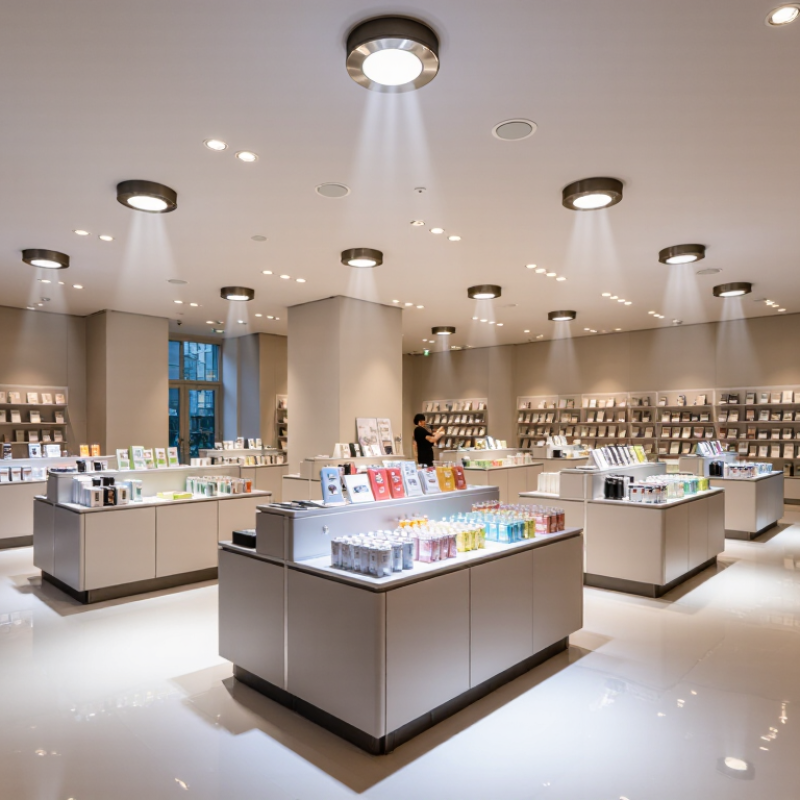
Table of Contents [Hide]
Assess the Space, Tasks, and Required Light Levels
Assess the room before choosing commercial downlights. A narrow corridor, a stocked shelf, and a computer desk need different beam spreads and light levels. Measure the working plane, usually the desk or counter, rather than judging brightness from the floor. Note ceiling height, surface colors, daylight, and likely shadows. Dark finishes absorb more light. A glossy counter may create glare.
Tip: List each task and its location. EN 12464-1:2021 gives 500 lux maintained illuminance as a reference for office reading, writing, and typing. Treat that as a starting point, not a universal target. A reception counter, meeting table, and circulation route may need different levels. Check the standard’s uniformity and glare criteria, too.
The IES Lighting Handbook also considers visual task, contrast, and viewing conditions when setting lighting criteria. Use these factors to estimate fixture spacing and beam angle; then confirm the result with a lighting calculation or on-site measurements.
Dimming can help when daylight changes, but it cannot fix poor placement. A neat plan can still feel harsh. Review the space at working hours, when screens, windows, and real tasks reveal what the drawing missed.