
-
- Products
- Indoor Household Cords
- Appliance Cords
- General Purpose Short-Length Cords
- General Purpose Extension Cords
- Landscape & Decorating Cords
- Bright Color Extension Cords
- Oil-Resistant Extension Cords
- Cold-Flex Extension Cords
- VividFlex Power Cords
- EXTREME All-Weather Cords
- Cord Management
- Task Lights
- Adapters & GFCI Devices
- Where to Buy
- About
- Careers
- Glossary
- Catalog


What Are the 2026 Top Red Light Therapy Bed Types?
Red light therapy is moving from niche wellness studios into dermatology clinics, recovery centers, and premium home spaces. The Red Light Therapy Bed now appears in several designs, including horizontal full-body beds, vertical booths, modular panel systems, and hybrid infrared platforms. Each type creates a different experience. A client may lie beneath hundreds of LEDs, stand inside a narrow booth, or adjust panels around the shoulders and legs.
Industry reports show why this category deserves careful comparison. Grand View Research’s Red Light Therapy Market Size, Share & Trends Analysis Report identifies strong market expansion through 2030, driven by wellness adoption and non-invasive cosmetic applications. Fortune Business Insights reports similar growth expectations, while noting differences in market definitions and product classifications. That matters. A market forecast is not clinical proof.
Professional selection requires more than counting LEDs. Buyers should examine wavelength ranges, irradiance, treatment distance, session controls, cooling, electrical safety, and manufacturer testing. The U.S. Food and Drug Administration distinguishes general wellness products from devices making medical claims. Therefore, “FDA cleared” should never be treated as a universal quality guarantee.
Some beds look impressive. Their specifications may be incomplete. This guide compares the leading 2026 bed types through practical use, engineering details, maintenance needs, and evidence quality. It also considers user comfort, room size, operating cost, and realistic treatment expectations. The strongest option may not be the most expensive model. It may be the one with transparent measurements, consistent output, and safer daily operation. Even this framework has limits, because independent testing remains uneven across the industry.
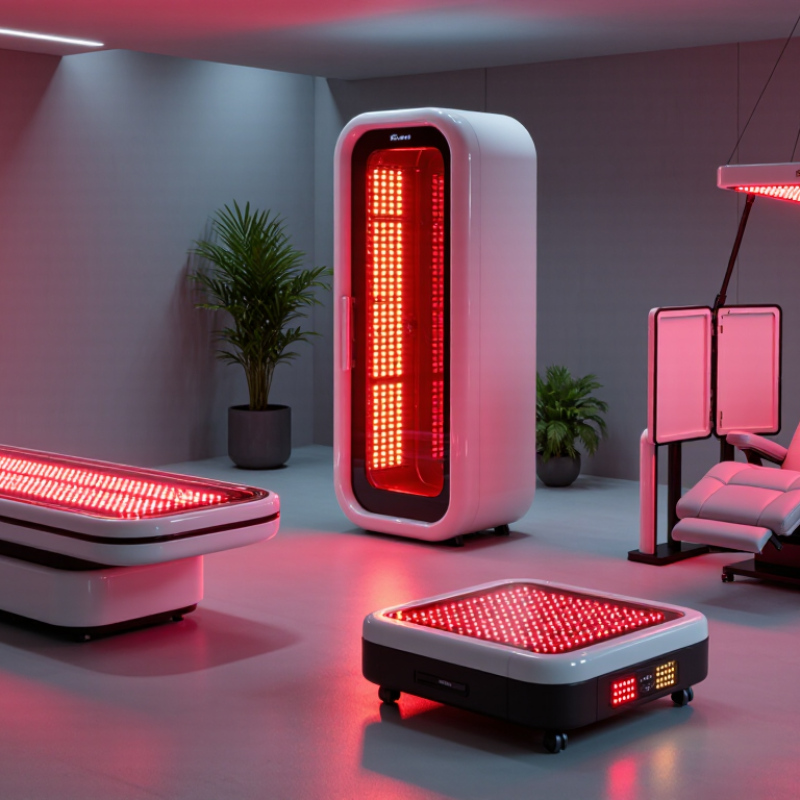
Table of Contents [Hide]
2026 Red Light Therapy Bed Taxonomy: Panels, Pods, Canopies, and Hybrids
What Are the 2026 Top Red Light Therapy Bed Types?
The 2026 taxonomy is clearer when organized by structure: panels, pods, canopies, and hybrids. Panels expose the body from one or several fixed surfaces. They are easier to install, inspect, and measure. However, treatment may feel uneven around the sides and back. Pods surround the user more completely, creating a controlled chamber-like experience. They usually demand more space, cleaning, and careful ventilation. Simple, but incomplete.
Canopies sit above the user, often covering the torso while leaving the sides open. They suit clinics and homes with limited floor space. Their main weakness is shadowing, especially around the shoulders and arms.
Hybrid beds combine panels, canopy sections, and sometimes targeted lower-body lighting. This design improves coverage, but more emitters can complicate dose control.
The International Electrotechnical Commission’s IEC 62471 framework supports photobiological safety assessment for lamps and light-emitting systems.
Market evidence supports cautious growth rather than instant certainty. Grand View Research estimated the global photobiomodulation market at approximately 1.1 billion dollars in 2023, with continued expansion through 2030. Separate 2024 industry assessments also identify wellness clinics and home devices as major demand areas. Yet market size does not prove clinical effectiveness.
Buyers should request wavelength ranges, irradiance at skin level, exposure time, and independent testing.
A bright bed is not automatically a better bed. In practice, coverage and measured dose often matter more than dramatic appearance.