
-
- Products
- Indoor Household Cords
- Appliance Cords
- General Purpose Short-Length Cords
- General Purpose Extension Cords
- Landscape & Decorating Cords
- Bright Color Extension Cords
- Oil-Resistant Extension Cords
- Cold-Flex Extension Cords
- VividFlex Power Cords
- EXTREME All-Weather Cords
- Cord Management
- Task Lights
- Adapters & GFCI Devices
- Where to Buy
- About
- Careers
- Glossary
- Catalog


7 Best Carton Flow Racking Systems for Global Buyers
For global buyers, choosing among Carton Flow Racking Systems is not simply a matter of comparing prices. The right design must match carton dimensions, picking frequency, warehouse temperature, labor habits, and replenishment space. A lane that works beautifully for small cosmetics cartons may struggle with heavy automotive parts. Real conditions matter.
Warehouse management author Gwynne Richards emphasizes, “The warehouse should be designed around the flow of goods, not just the storage of goods.” This principle is especially useful when evaluating carton flow racks. Gravity rollers, skate wheels, FIFO lanes, adjustable dividers, and inclined shelving can each solve a different operational problem. However, no single configuration is ideal for every facility.
This guide reviews seven Carton Flow Racking Systems suitable for international purchasing decisions. It considers load capacity, carton stability, picking speed, installation requirements, maintenance, and long-term flexibility. Details such as a 30-millimeter carton overhang or a poorly adjusted lane can create daily friction. Small mistakes become expensive at scale.
Not every supplier’s specification tells the complete story. Ask for tested load ratings, component materials, warranty terms, and replacement-part availability. Confirm whether the rack supports your actual cartons, not an assumed sample. That step is often missed.
The comparison also recognizes practical limitations. A high-density system may reduce walking but complicate replenishment. A low-cost frame may require more frequent adjustments. Reliable buying decisions come from observing the workflow, measuring the cartons, and questioning attractive promises. Performance should be verified on the warehouse floor.
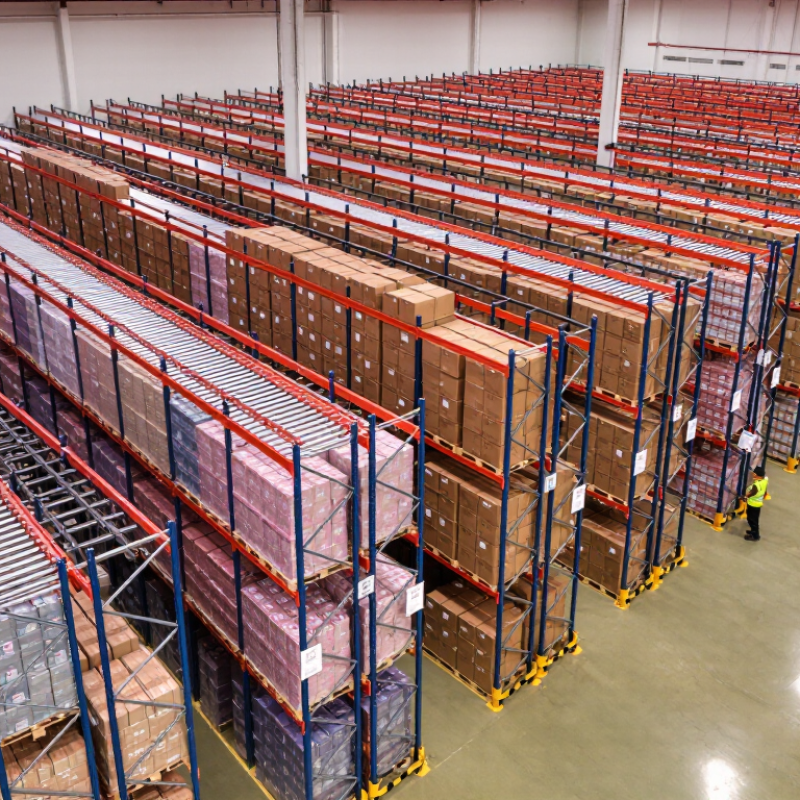
Table of Contents [Hide]
Carton Flow Racking: Definition, Structure, and Operating Principles
Carton flow racking is a gravity-fed storage system for cartons, totes, or small cases. It uses inclined roller lanes, a loading face, and a separate picking face. Workers load products from the rear and pick them from the front. Each lane usually includes side frames, rollers, guide rails, and a stop. Simple structure. The roller pitch must match carton size and bottom stiffness. Otherwise, containers may stall, tilt, or accelerate unexpectedly.
A 2024 material-handling industry report recorded cloud-computing use at 55% among surveyed supply-chain organizations. This reflects a wider move toward connected inventory control. The 2023 Global Parcel Shipping Index estimated 161.8 billion parcels worldwide in 2022. Such volume increases pressure on fast, repeatable carton picking. Flow racking helps by shortening walking distances and presenting older stock first. Its first-in, first-out behavior is useful for dated products.
The operating principle is direct. An operator replenishes from the back. Gravity moves each carton toward the picking face. A separator or brake roller controls forward motion. Pickers remove the front carton, and the next carton advances automatically. Lane labels should show SKU, quantity, and replenishment limits. In practice, the design is not flawless. Dust, damaged cartons, and uneven loads can reduce flow. Some lanes still need manual adjustment. Testing with real carton samples remains more reliable than relying only on drawings or theoretical load data.