
-
- Products
- Indoor Household Cords
- Appliance Cords
- General Purpose Short-Length Cords
- General Purpose Extension Cords
- Landscape & Decorating Cords
- Bright Color Extension Cords
- Oil-Resistant Extension Cords
- Cold-Flex Extension Cords
- VividFlex Power Cords
- EXTREME All-Weather Cords
- Cord Management
- Task Lights
- Adapters & GFCI Devices
- Where to Buy
- About
- Careers
- Glossary
- Catalog


10 Best Deep Boring Machine Suppliers Worldwide
Deep Boring Machines form a specialized segment within the wider machine tool industry. They create precise, narrow holes through long metal components. Typical applications include hydraulic cylinders, oilfield parts, aerospace landing gear, and energy equipment.
The market deserves careful examination. Fortune Business Insights reported that the global machine tools market reached approximately USD 86.9 billion in 2023. Its forecast indicates continued growth through 2030. Grand View Research also identifies automation, computer numerical control, and advanced manufacturing as major development drivers. However, these reports rarely isolate Deep Boring Machine sales. That limitation matters. Supplier rankings should not rely on market size alone.
Joseph M. Juran, a leading manufacturing-quality authority, offered a relevant warning: “Quality does not happen by accident; it must be planned.” His principle applies directly to deep boring performance. Buyers should examine spindle stability, boring-bar support, coolant filtration, chip evacuation, dimensional accuracy, and after-sales service. A polished brochure proves little.
The strongest suppliers usually provide trial machining, inspection records, installation guidance, and documented tolerance results. A 12-meter workpiece can expose weaknesses that a small sample hides. This guide compares ten global suppliers through product capability, engineering experience, production scale, service coverage, and customer suitability.
Some rankings remain debatable. Public data is inconsistent across regions. Therefore, the list should support technical evaluation, not replace it. Before purchasing, manufacturers should request reference parts, verify achievable tolerances, and confirm local maintenance support. Price matters. Reliability matters more.
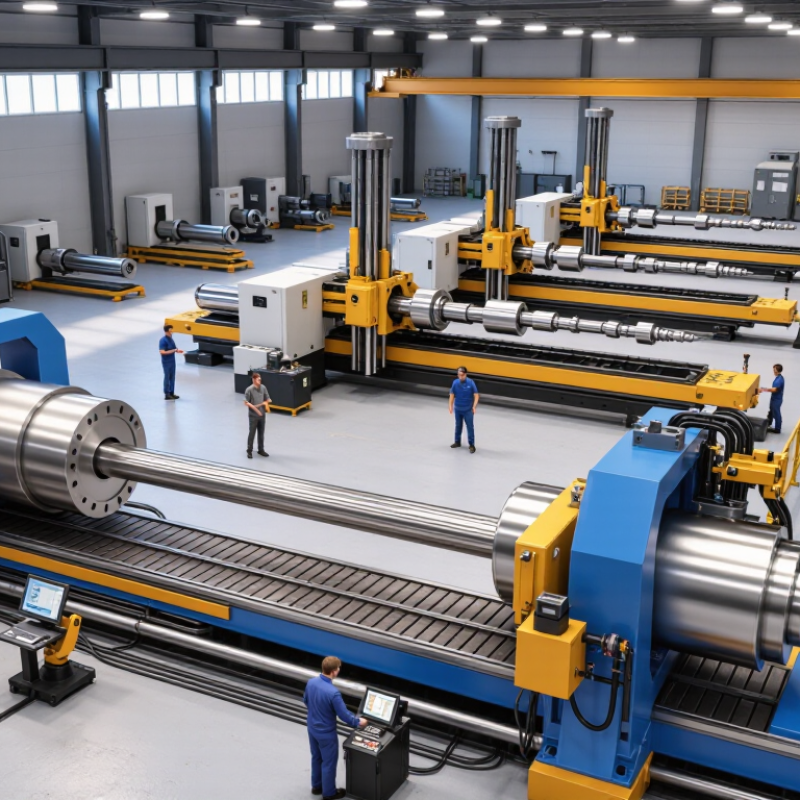
Table of Contents [Hide]
What Is a Deep Boring Machine and Where Is It Used?
A deep boring machine creates or enlarges long, accurate internal holes in metal components. Unlike ordinary drilling, it controls tool alignment, chip removal, and bore geometry across unusual depths. A common benchmark is a depth-to-diameter ratio above 10:1, although the practical limit depends on material, tooling, and machine rigidity.
These machines typically use BTA, ejector, or single-tube systems. High-pressure cutting fluid carries chips away while supporting stable cutting. Operators check straightness, surface roughness, diameter tolerance, and thermal growth.
Accuracy matters. Hydraulic cylinders, injection molds, aerospace landing-gear parts, crankshafts, and energy equipment often require this process. A small alignment error can become significant near the bore’s end.
Demand is linked to broader manufacturing investment. Fortune Business Insights valued the global CNC machine tools market at approximately USD 81.95 billion in 2023 and projects about USD 128.41 billion by 2032. The International Federation of Robotics recorded 541,302 industrial robot installations worldwide in 2023, indicating stronger pressure for repeatable production. These figures cover wider sectors, not deep boring alone. That distinction matters.
When comparing suppliers, buyers should request test-bore records, tolerance data, coolant-pressure specifications, and service response times. Published capacity can look impressive, yet real performance may change with hardened steel, thin walls, or very long components. A machine that meets diameter targets may still produce unacceptable waviness. Suppliers should explain those limitations honestly.