-
- Products
- Indoor Household Cords
- Appliance Cords
- General Purpose Short-Length Cords
- General Purpose Extension Cords
- Landscape & Decorating Cords
- Bright Color Extension Cords
- Oil-Resistant Extension Cords
- Cold-Flex Extension Cords
- VividFlex Power Cords
- EXTREME All-Weather Cords
- Cord Management
- Task Lights
- Adapters & GFCI Devices
- Where to Buy
- About
- Careers
- Glossary
- Catalog


2026 Best Types of Greenhouse Pipe for Global Buyers?
Choosing the best Greenhouse Pipe for global buyers in 2026 requires more than comparing prices.
A pipe carries the structure, not merely the crop-covering film. It must withstand wind, snow, humidity, fertilizer residues, and repeated installation stress. Field experience shows that a low-cost tube can become expensive after one rust season. That lesson is easy to ignore.
The market context is becoming more demanding. FAO’s The State of Food and Agriculture 2024 highlights the need for more efficient, resilient food production systems. Protected cultivation supports that direction, especially where land, water, and climate create production pressure. Meanwhile, World Steel Association data reports global crude steel production above 1.8 billion tonnes annually, confirming the scale and complexity of steel sourcing worldwide. Quality still varies between suppliers.
For buyers, the practical choice usually involves hot-dip galvanized steel pipe, pre-galvanized tube, stainless steel pipe, aluminum profiles, or specialized coated products. Each option balances strength, corrosion resistance, weight, cost, and local availability. ISO 1461 can help evaluate hot-dip galvanizing quality, while EN 10219 and ASTM structural tube specifications provide useful dimensional and mechanical references. These standards do not replace inspection.
They support better decisions.
Regional climate matters greatly. A coastal greenhouse may need stronger corrosion protection, while a high-snow area needs verified load calculations and thicker wall sections. World Bank commodity reports also show why steel-price volatility can affect long-term procurement planning. However, market reports cannot predict every supplier’s workmanship.
This guide compares the main Greenhouse Pipe types for international buyers. It focuses on durability, coatings, specifications, logistics, and lifecycle value. There is no universally best pipe. The better answer depends on the greenhouse’s climate, span, budget, and maintenance capacity. That is the part buyers should question carefully.
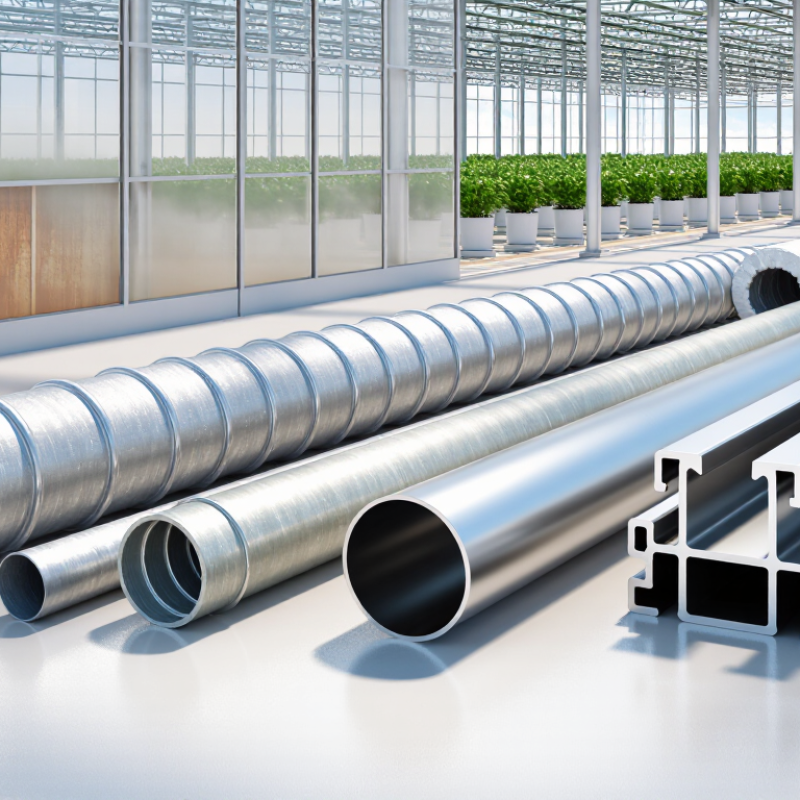
Table of Contents [Hide]
What Is Greenhouse Pipe and Why Does It Matter?
Greenhouse pipe is the tubular material used to build frames, roof supports, sidewalls, crop rails, and service lines. It gives a greenhouse its shape and helps it resist wind, rain, crop weight, and repeated opening of vents. The wrong pipe can bend quietly before failure becomes visible.
Galvanized steel pipe remains a practical choice for large structures because its zinc coating helps slow rust. It is strong, widely available, and suitable for heavier spans. Aluminum pipe is lighter and easier to handle during installation, but it may need thicker walls or closer supports. PVC pipe can serve irrigation or temporary structures, although it is usually less suitable for major load-bearing frames.
Dimensions matter as much as material. Check outside diameter, wall thickness, coating quality, connection style, and actual load calculations. A pipe that looks heavy may have a thin wall. It can disappoint.
In humid coastal regions, inspect cut edges, welds, and joints carefully because corrosion often starts there. Buyers should request test data, tolerances, coating details, and installation guidance from qualified suppliers. Local wind and snow requirements also deserve attention. A design suitable for a mild valley may fail on an exposed farm. I have seen projects prioritize low purchase prices, then spend more on replacements and labor. That choice is not always wrong, but it needs honest risk assessment. Compatibility matters too: mismatched clamps can crush thin walls or loosen after temperature changes.
2026 Best Types of Greenhouse Pipe for Global Buyers? - What Is Greenhouse Pipe and Why Does It Matter?
Greenhouse pipe is a tube or hollow section used for structural framing, ventilation, crop support, irrigation, heating, or drainage. The correct pipe material affects load capacity, corrosion resistance, service life, installation cost, and suitability for different climates.
| Pipe Type | Typical Material or Grade | Common Dimensions | Typical Greenhouse Application | Key Advantages | Main Limitations | Corrosion Resistance | Typical Service-Life Range* | Best Climate or Use Case |
|---|---|---|---|---|---|---|---|---|
| Hot-Dip Galvanized Steel Pipe | Carbon steel with a zinc coating applied after fabrication; commonly supplied to structural or tube standards. | Outside diameter: approximately 19–76 mm Wall thickness: approximately 1.0–3.0 mm | Main frames, columns, arches, sidewalls, purlins, doors, and crop-support structures. | High strength, widely available, suitable for bolted or welded structures, and economical for medium- to large-scale greenhouses. | Heavier than aluminum or polymer pipe; cut or welded areas require corrosion protection; zinc coating can be affected by acidic or salty environments. | High in normal outdoor conditions; higher protection is available with thicker zinc coatings or duplex coating systems. | Approximately 15–30 years, depending on coating thickness, humidity, salt exposure, and maintenance. | Most climates, including commercial greenhouses exposed to wind, snow, or repeated seasonal loading. |
| Pre-Galvanized Steel Tube | Cold-formed steel tube coated with zinc before forming; coating quality varies by product specification. | Outside diameter: approximately 19–60 mm Wall thickness: approximately 0.8–2.5 mm | Light greenhouse frames, cross-bracing, benches, shelving, trellis supports, and secondary members. | Lower initial cost, good dimensional consistency, easy cutting and assembly, and adequate strength for light-duty structures. | Exposed cut edges and weld zones may rust sooner; generally less suitable than hot-dip galvanized pipe for highly humid or saline conditions. | Moderate to high, depending on zinc coating mass and environmental exposure. | Approximately 8–20 years in typical greenhouse conditions. | Dry or moderately humid regions and economical small- to medium-sized structures. |
| Aluminum Pipe or Tube | Common structural aluminum alloys such as heat-treatable 6000-series alloys. | Outside diameter: approximately 20–80 mm Wall thickness: approximately 1.0–3.0 mm | Frames, glazing bars, roof members, doors, vents, benches, and lightweight modular structures. | Low density, naturally protective oxide layer, easy handling, good appearance, and strong resistance to atmospheric corrosion. | Lower stiffness and strength than many steel sections; thermal expansion is relatively high; galvanic corrosion can occur when directly joined to some dissimilar metals. | High in most atmospheric environments; additional care is needed in coastal or chemically aggressive conditions. | Approximately 25–40 years or more with suitable design and maintenance. | Regions where lightweight construction, fast installation, and corrosion resistance are priorities. |
| Stainless Steel Pipe | Usually austenitic stainless steel, such as corrosion-resistant 300-series grades, selected according to exposure. | Outside diameter: approximately 20–76 mm Wall thickness: approximately 1.0–3.0 mm | High-value greenhouse frames, hygienic crop-support systems, food-production areas, fittings, and components exposed to aggressive moisture. | Excellent corrosion resistance, high cleanliness, long service life, and strong resistance to many fertilizers and cleaning chemicals. | High material cost; fabrication and joining require suitable tools and compatible fasteners; not always economical for the entire frame. | Very high, although chloride-rich environments can still cause localized corrosion if the grade or maintenance is unsuitable. | Approximately 30–50 years or more, subject to grade selection and exposure. | Coastal areas, high-humidity sites, hygienic production, and facilities using frequent chemical cleaning. |
| PVC or uPVC Pipe | Rigid polyvinyl chloride used mainly for water distribution, drainage, and low-load services. | Outside diameter: approximately 16–110 mm Pressure class and wall thickness vary by pipe standard. | Irrigation lines, nutrient-solution distribution, drainage, condensate removal, and non-structural service piping. | Lightweight, electrically non-conductive, resistant to many fertilizers and salts, smooth internal surface, and easy solvent or mechanical joining. | Not normally suitable for primary structural frames; can become brittle under prolonged ultraviolet exposure or low temperatures; softens at elevated temperatures. | High against many common agricultural chemicals, but compatibility should be checked for concentrated chemicals and solvents. | Approximately 10–25 years outdoors, depending on UV stabilization, pressure, temperature, and installation quality. | Irrigation and drainage systems where low weight and chemical resistance matter more than structural strength. |
| HDPE Pipe | High-density polyethylene, commonly specified for water, irrigation, and fertigation systems. | Outside diameter: approximately 16–160 mm Wall thickness depends on pressure rating and pipe series. | Buried or exposed irrigation mains, fertigation lines, drainage, and flexible water distribution. | Good impact resistance, flexibility, resistance to many agricultural chemicals, and reliable leak-resistant fusion joining. | Not a primary structural material; thermal expansion is significant; direct sunlight requires UV-stabilized material; pressure capacity decreases as temperature rises. | Very high against many salts, acids, and alkalis used at controlled agricultural concentrations. | Approximately 25–50 years for properly selected and installed water systems. | Large irrigation networks, uneven terrain, buried services, and systems requiring flexible pipe runs. |
| Fiberglass-Reinforced Plastic Pipe | Glass-fiber reinforcement embedded in a resin matrix, with resin selected for the chemical and temperature environment. | Outside diameter: approximately 25–150 mm Wall thickness varies according to pressure and structural design. | Specialized irrigation, chemical-resistant service lines, drainage, and selected lightweight structural or support components. | Low weight, high corrosion resistance, good dimensional stability, and useful performance in chemically aggressive environments. | Higher purchase and fabrication cost than common plastic pipe; can be damaged by impact; joints and supports require careful engineering. | High to very high when the resin system is correctly matched to the chemicals and temperature. | Approximately 20–40 years, depending on resin type, UV exposure, pressure, and maintenance. | Industrial-scale or chemically aggressive greenhouse operations where conventional metals may corrode quickly. |
*Service-life figures are typical planning ranges rather than guarantees. Actual performance depends on pipe quality, wall thickness, coating or resin system, structural loading, ultraviolet exposure, humidity, salinity, fertilizer concentration, installation method, and maintenance. Structural pipe should be selected according to local building codes, wind and snow loads, and an engineer’s design.