
-
- Products
- Indoor Household Cords
- Appliance Cords
- General Purpose Short-Length Cords
- General Purpose Extension Cords
- Landscape & Decorating Cords
- Bright Color Extension Cords
- Oil-Resistant Extension Cords
- Cold-Flex Extension Cords
- VividFlex Power Cords
- EXTREME All-Weather Cords
- Cord Management
- Task Lights
- Adapters & GFCI Devices
- Where to Buy
- About
- Careers
- Glossary
- Catalog


How to Choose a Dry Type Transformer in 2026?
Choosing a dry type transformer in 2026 requires more than comparing kVA ratings and purchase prices. Modern facilities face rising electricity demand, stricter efficiency expectations, limited indoor space, and higher fire-safety concerns. The International Energy Agency’s Electricity 2024 report projects global electricity demand to grow strongly through 2026, driven by data centers, industry, cooling, and electrification. That pressure makes transformer losses, thermal performance, and service life financially important.
Begin with the load profile. Record peak demand, harmonics, motor starting current, ambient temperature, altitude, and future expansion. A 1,000 kVA unit may look adequate on paper, yet repeated overloads can raise winding temperature and shorten insulation life. No checklist is perfect. Real operating conditions matter.
IEEE Fellow John D. McDonald, a recognized power-system engineer and transformer author, offers a practical principle: “Start with the load profile, not the transformer brochure.” That advice should guide every specification. Compare cast-resin and VPI designs, then verify compliance with IEC 60076-11 or applicable IEEE standards. Review noise data, enclosure protection, partial-discharge performance, cooling class, and maintenance access.
Industry research also signals sustained demand. MarketsandMarkets has forecast continued growth in the dry-type transformer market, supported by renewable projects, commercial buildings, and infrastructure upgrades. However, market growth does not guarantee a suitable product. A lower initial price can hide ventilation costs, harmonic derating, difficult replacement access, or weak after-sales support.
This guide explains how to select a dry type transformer that fits the electrical system, installation environment, safety objectives, and realistic operating future.
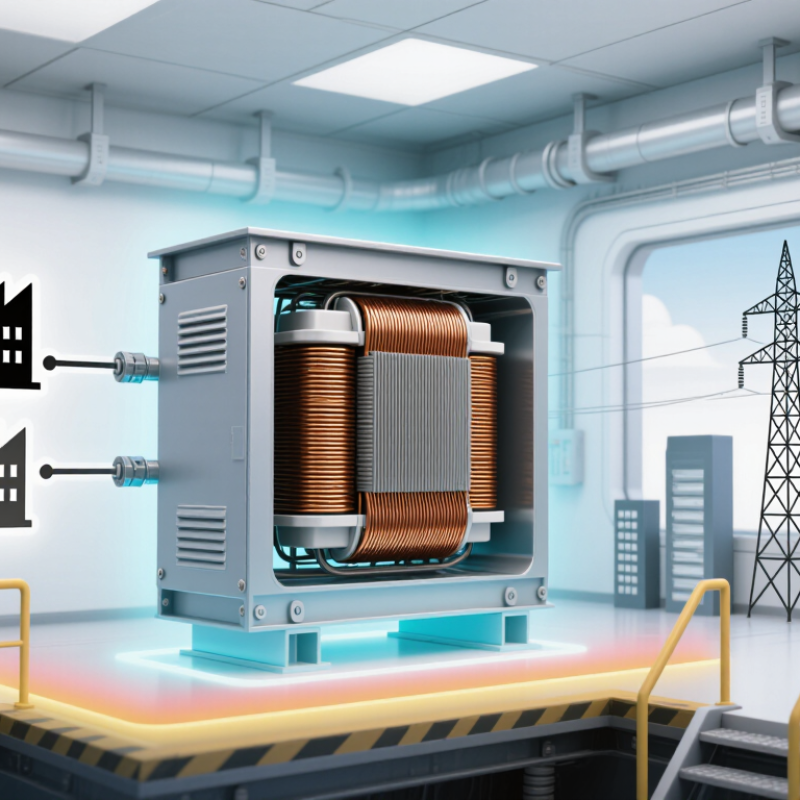
Table of Contents [Hide]
Define Dry-Type Transformers and Their Main Applications
How to Choose a Dry Type Transformer in 2026?
Define Dry-Type Transformers and Their Main Applications
A dry-type transformer transfers electrical energy without liquid insulation or cooling oil. Its windings use air, resin, or solid insulation materials for electrical separation. This design reduces leakage risks and simplifies indoor installation. It is often selected for buildings where fire safety and clean operation matter.
Common applications include hospitals, schools, offices, factories, data centers, and underground facilities. Dry-type units also support solar plants, battery systems, and industrial control equipment. A hospital may place one near critical loads, while a factory may use it beside motor control panels. Each location has different demands for noise, heat, dust, and available space.
Choosing the correct unit requires more than checking voltage and capacity. Engineers should review load patterns, harmonic currents, ambient temperature, altitude, enclosure rating, and ventilation. Standards such as IEC 60076-11 and IEEE C57.12.01 can support a reliable technical evaluation. Field inspections often reveal a simple problem: the room has enough floor space, but not enough cooling airflow. That detail is easy to miss.
A practical selection also considers future expansion. Oversizing can increase cost and reduce efficiency at light loads. Undersizing can cause overheating during peak operation. The first estimate is not always right. Measure real demand, discuss operating conditions, and confirm protection settings before installation.