
-
- Products
- Indoor Household Cords
- Appliance Cords
- General Purpose Short-Length Cords
- General Purpose Extension Cords
- Landscape & Decorating Cords
- Bright Color Extension Cords
- Oil-Resistant Extension Cords
- Cold-Flex Extension Cords
- VividFlex Power Cords
- EXTREME All-Weather Cords
- Cord Management
- Task Lights
- Adapters & GFCI Devices
- Where to Buy
- About
- Careers
- Glossary
- Catalog


How to Choose a Kraft Paper Tape Laminating Machine?
Selecting the right Kraft Paper Tape Laminating Machine is a production decision, not a catalogue exercise. Packaging lines now face stronger pressure to reduce plastic use, improve recyclability, and control operating costs. Smithers’ report, The Future of Global Packaging to 2028, identifies sustainability and material efficiency as major forces shaping packaging investment. These trends make kraft paper tape increasingly relevant for carton sealing, bundling, and industrial packaging applications.
However, a greener material does not guarantee efficient production. A suitable machine must match paper grammage, tape width, adhesive chemistry, coating weight, drying capacity, and expected line speed. Small differences matter. Excessive web tension can wrinkle a 60-gram kraft paper roll. Poor adhesive control can create edge lift after storage. A slow drying section may reduce output during humid weather. These details deserve practical testing.
Performance matters most.
PMMI industry reports consistently emphasize automation, uptime, labor efficiency, and flexible equipment design as key packaging machinery priorities. Therefore, buyers should examine measurable evidence, including stable tension control, coating uniformity, changeover time, energy consumption, and reject rates. Factory trials are valuable because laboratory samples rarely reveal every production problem. I have seen specifications look convincing until operators tested actual paper rolls and adhesive batches.
This guide explains how to evaluate a Kraft Paper Tape Laminating Machine with technical judgment. It also questions common assumptions, including the belief that maximum speed always delivers the best return. A reliable machine should support consistent quality, maintainable operation, and realistic growth. The final choice should reflect current production needs, operator experience, and verified supplier performance.
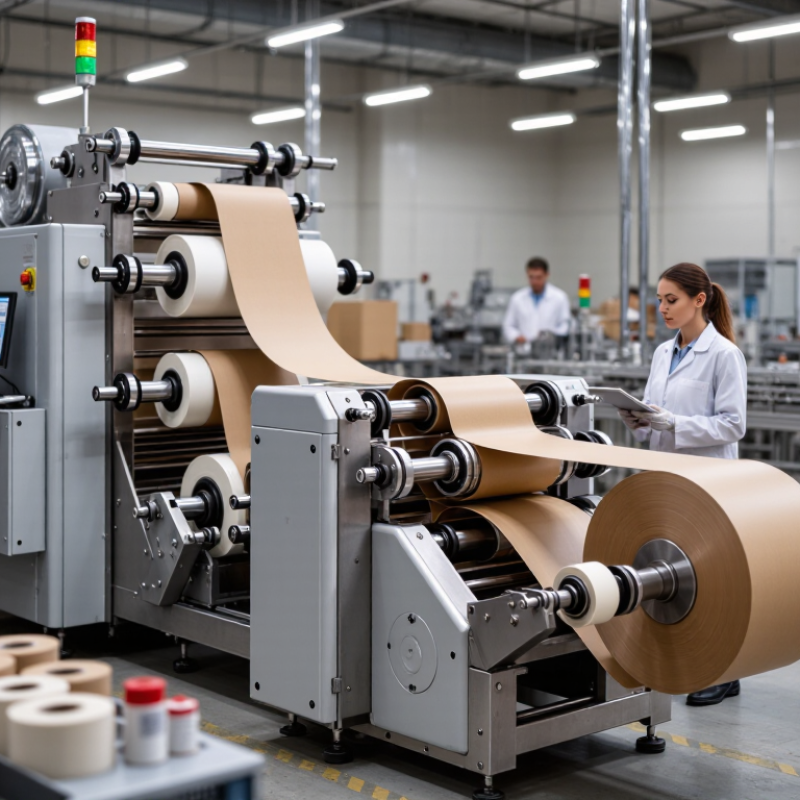
Table of Contents [Hide]
Understanding Kraft Paper Tape Laminating Machines
How to Choose a Kraft Paper Tape Laminating Machine?
Understanding Kraft Paper Tape Laminating Machines
A kraft paper tape laminating machine bonds paper with adhesive, film, or another functional layer. Its core work involves unwinding, coating, laminating, drying, and rewinding. Each stage affects tape strength and appearance. A stable tension system prevents wrinkles along the roll. Heated rollers may improve bonding, but excessive heat can weaken paper fibers. Ask about substrate width, thickness, adhesive type, and production speed before choosing equipment. These details determine whether the machine suits your actual process.
Tips: Request a trial using your kraft paper, adhesive, and target width. Inspect the sample under bright light. Look for bubbles, edge lifting, uneven coating, and loose winding. Check whether operators can adjust pressure and tension without complicated procedures. A clear control panel also reduces training time. Do not judge performance from speed alone.
In practical testing, a machine may perform well at low speed but struggle during continuous production. That difference matters. Review drying capacity, roller alignment, cleaning access, and spare-part availability. Ask how often key parts require inspection. Reliable machines usually provide measurable settings and repeatable results. However, no selection is perfect. Paper humidity, adhesive viscosity, and operator habits can still change the outcome. Keep test records, including room conditions and batch details. This helps identify whether a defect comes from the machine or the material.