
-
- Products
- Indoor Household Cords
- Appliance Cords
- General Purpose Short-Length Cords
- General Purpose Extension Cords
- Landscape & Decorating Cords
- Bright Color Extension Cords
- Oil-Resistant Extension Cords
- Cold-Flex Extension Cords
- VividFlex Power Cords
- EXTREME All-Weather Cords
- Cord Management
- Task Lights
- Adapters & GFCI Devices
- Where to Buy
- About
- Careers
- Glossary
- Catalog


How to Choose the Right Axial Duct Fans for Your Needs?
Choosing the right Axial Duct Fans begins with the air problem, not the product catalogue. A fan must move the required airflow through real ductwork, bends, filters, grilles, and dampers. A model that looks powerful on paper may struggle when resistance increases. That mistake is surprisingly common.
Dr. William P. Bahnfleth, a respected ASHRAE ventilation researcher, offers a useful reminder: “Ventilation is not a magic bullet.” His point applies directly to fan selection. Axial Duct Fans can support effective air movement, but they cannot correct poor duct design, blocked outlets, or inadequate maintenance. The complete system matters.
This guide examines the decisions that deserve careful attention. You will consider airflow volume, static pressure, noise, motor efficiency, installation space, temperature, and control requirements. A warehouse may need high-volume extraction near the roof. A commercial kitchen may demand stronger pressure performance and grease-resistant construction. A small workshop might need quieter operation beside occupied workstations.
Measure the duct route.
Do not guess.
Real-world experience also exposes uncomfortable details. Manufacturer performance data may use ideal test conditions. Your installation will rarely be ideal. Dust can build on blades. Dampers may remain partly closed. Electrical supply can limit motor selection. These details can change results.
The best choice balances performance, energy use, durability, and service access. It may not be the largest fan. It may not be the cheapest one. Careful selection creates dependable ventilation, safer operation, and fewer expensive adjustments after installation.
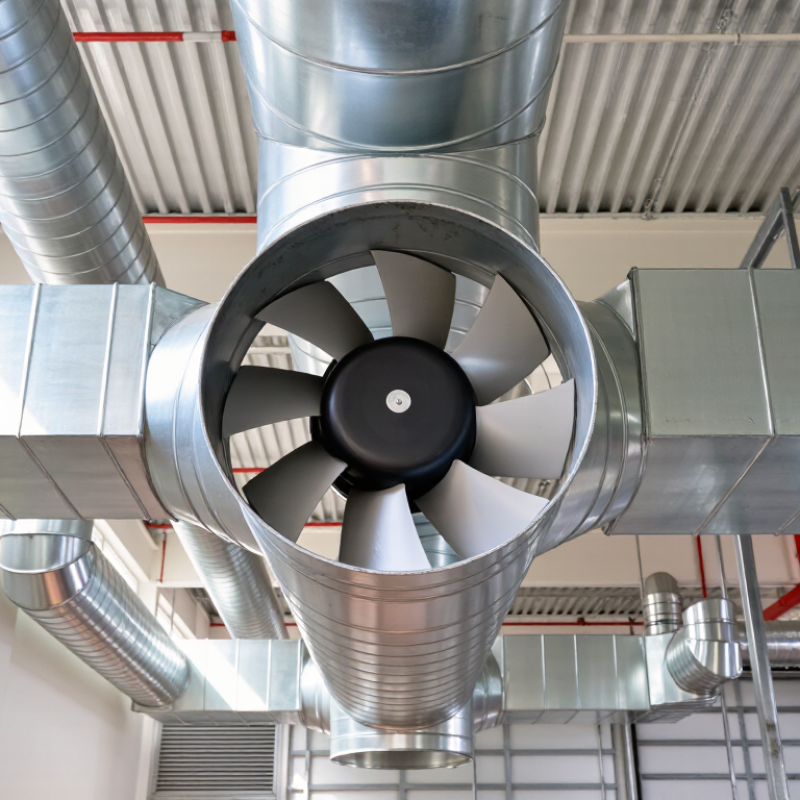
Table of Contents [Hide]
Define Required Airflow and Static Pressure in CFM and Pa Using AMCA 210
How to Choose the Right Axial Duct Fans for Your Needs?
Start with airflow, not fan size. Calculate required airflow in CFM from room volume and air changes per hour.
For example, a 1,200-cubic-foot room requiring six air changes needs about 120 CFM.
This figure describes volume movement, not resistance. Static pressure, measured in pascals, represents the resistance created by ducts, filters, grilles, dampers, and bends.
List every pressure loss in the system. Then add a reasonable safety margin, usually 10–15%, without over-sizing the fan.
The U.S. Department of Energy’s Improving Fan System Performance sourcebook reports that fan systems can represent roughly 10–20% of industrial electricity consumption. Efficient selection matters. Excessive pressure capacity can increase noise and energy use.
Use AMCA 210 test data when comparing axial duct fans. The standard defines laboratory methods for measuring airflow, pressure, power, and efficiency under controlled conditions.
Match the required operating point, such as 120 CFM at 180 Pa, with the published performance curve.
Do not compare free-air airflow with tested system airflow. That mistake is common.
In real installations, my first pressure estimate is often too optimistic. A dusty filter or undersized grille can change the result quickly. ASHRAE Handbook guidance also supports evaluating the complete air-distribution system, rather than selecting a fan from airflow alone.