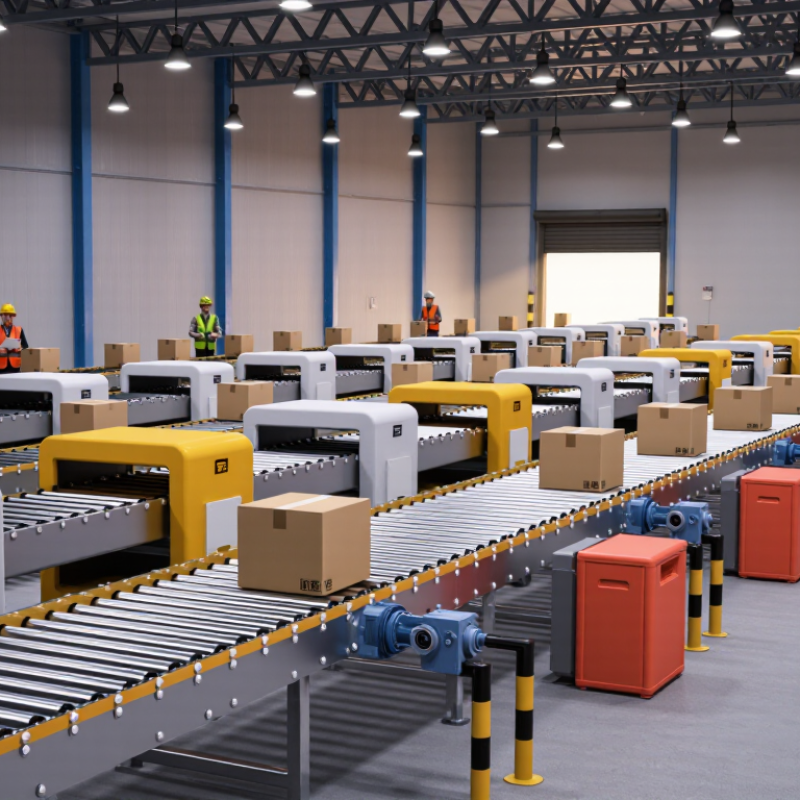
| Conveyor Type | Gravity roller Powered roller Accumulation Flexible roller | Selection based on product weight, dimensions, required throughput, accumulation needs, and available floor space. | Can the supplier recommend the correct conveyor type for cartons, totes, pallets, or irregular loads? | Application assessment, layout proposal, and product-handling analysis. |
| Roller Diameter | Common roller diameters include approximately 38, 50, 60, 76, and 89 mm, depending on load and conveyor design. | Roller diameter, wall thickness, shaft design, and pitch should be matched to the load and support requirements. | How is the roller diameter selected for the minimum product size and maximum load? | Technical drawings, roller specifications, and load calculations. |
| Load Capacity | Capacity may range from light-duty carton handling to several hundred kilograms per meter for pallet applications. The actual rating depends on roller pitch, frame, supports, and load distribution. | Published capacity should identify whether the rating applies per roller, per conveyor section, or per linear meter. | What is the rated load per roller and per conveyor section under the proposed operating conditions? | Load tables, structural calculations, and a documented safety factor. |
| Product Dimensions | Conveyor widths are commonly designed around the product footprint, with sufficient side clearance and at least three supporting rollers beneath a rigid load whenever practical. | The supplier should verify product length, width, height, weight distribution, bottom surface, and center of gravity. | What are the minimum and maximum product dimensions that the proposed conveyor can handle? | Product samples, dimensional drawings, and test-run records. |
| Roller Pitch | Typical pitch is selected so that the load remains supported by multiple rollers. Smaller products generally require a shorter pitch. | Pitch should be calculated from the shortest load length rather than selected only from standard modules. | How many rollers will support the shortest product during transfer and accumulation? | Layout drawings showing roller pitch and product contact points. |
| Conveyor Speed | Many powered roller systems operate within a broad range of approximately 0.1 to 1.0 m/s, while the correct speed depends on product stability, spacing, and process requirements. | Speed should be adjustable where product types, safety requirements, or downstream equipment vary. | Is the speed fixed, variable, or recipe-controlled? What is the acceleration and stopping behavior? | Motor data, speed-control specifications, and commissioning test results. |
| Drive and Motor System | Common solutions include motorized rollers, chain-driven rollers, line-shaft systems, and geared motors with variable-frequency drives. | The drive system should be sized for starting torque, continuous duty, accumulation, incline conditions, and duty cycle. | What motor sizing method is used, and how are starting loads and accumulation zones handled? | Motor calculations, wiring diagrams, drive datasheets, and duty-cycle information. |
| Accumulation Function | Zero-pressure or minimum-pressure accumulation can be used to reduce product contact and protect sensitive goods. | Zones, sensors, controls, and release logic should be designed according to product spacing and system throughput. | Can the system provide zero-pressure accumulation, and how is zone control implemented? | Zone layout, control sequence, sensor list, and functional test report. |
| Frame and Roller Materials | Painted carbon steel is widely used for general industrial applications. Stainless steel and galvanized components are used where corrosion resistance or washdown requirements apply. | Material selection should consider humidity, cleaning chemicals, temperature, corrosion exposure, and hygiene requirements. | Which components are stainless steel, galvanized, coated, or untreated, and why were they selected? | Material certificates, coating details, corrosion-resistance information, and finish samples. |
| Layout and Customization | Common configurations include straight sections, curves, merges, diverts, transfers, inclines, declines, and adjustable support structures. | The supplier should be able to produce a complete layout that includes interfaces with packing, storage, scanning, and control systems. | Can the supplier design around existing columns, doors, equipment, utilities, and restricted access areas? | 2D or 3D layout, interface drawings, elevation plan, and installation clearances. |
| Controls and Integration | Systems may include photoelectric sensors, programmable logic controllers, variable-frequency drives, barcode scanners, and warehouse-control interfaces. | Control architecture, communication protocols, safety circuits, and ownership of integration responsibilities should be clearly defined. | Which controls are included, and who is responsible for connecting the conveyor to upstream and downstream equipment? | Control architecture, I/O list, network requirements, software sequence, and integration matrix. |
| Safety Design | Typical provisions include emergency stops, guarding at hazardous points, accessible isolation points, warning labels, and safe maintenance access. | The supplier should perform a documented risk assessment and design safety measures appropriate to the installation environment. | What safety standard, risk-assessment method, and lockout procedure are applied to the system? | Risk assessment, safety-circuit drawings, guarding plan, and safety validation records. |
| Manufacturing Quality | Important controls include dimensional inspection, weld quality, roller runout, coating inspection, electrical testing, and functional testing. | Quality checks should be defined before production and linked to measurable acceptance criteria. | Which inspections are completed before shipment, and what tolerances are recorded? | Inspection and test plan, quality records, nonconformance procedure, and factory acceptance test report. |
| Testing and Acceptance | Testing should reproduce the intended product, load, speed, accumulation behavior, sensors, and operating sequence whenever possible. | A formal factory acceptance test and site acceptance test should define pass/fail conditions. | Can the supplier perform a loaded test using representative products before delivery? | FAT and SAT procedures, test videos, measured results, and signed acceptance documents. |
| Installation and Commissioning | Installation may include mechanical assembly, leveling, electrical connection, sensor setup, controls commissioning, operator training, and handover. | Responsibilities, site requirements, tools, labor, travel, and commissioning duration should be specified in the quotation. | What work is included in installation, and what site preparation must the customer complete? | Installation method statement, project schedule, site-readiness checklist, and commissioning plan. |
| Maintenance and Spare Parts | Typical service items include rollers, bearings, belts or chains, sensors, motors, drive components, and fasteners. | The supplier should provide preventive-maintenance intervals, recommended spare parts, troubleshooting guidance, and component identification. | Which parts are critical, how quickly can they be supplied, and are standard replacement parts available locally? | Maintenance manual, spare-parts list, parts drawings, service procedure, and response-time policy. |
| Documentation | A complete project file normally includes general arrangement drawings, electrical schematics, manuals, parts lists, certificates, and test records. | Documentation should be supplied in the required language and updated to reflect the final as-built system. | Will the supplier provide final as-built drawings and editable files after commissioning? | Document register, sample manuals, drawing templates, and final handover package. |
| Project Schedule | Lead time varies with system complexity, customization, controls scope, material availability, testing, and installation requirements. | The supplier should provide milestone dates rather than only a single estimated delivery date. | What are the dates for design approval, procurement, fabrication, factory testing, shipment, installation, and handover? | Detailed project schedule, manufacturing milestones, progress-report format, and delay-management process. |
| Commercial Evaluation | Total cost should include equipment, controls, packaging, freight, installation, commissioning, training, spare parts, and future maintenance. | The quotation should clearly separate included items, exclusions, optional items, taxes, delivery terms, and payment conditions. | Is the offer being compared on purchase price only or on total cost of ownership? | Itemized quotation, bill of materials, lifecycle-cost estimate, warranty terms, and payment schedule. |
| Supplier Experience | Relevant experience is more valuable when it matches the product type, load range, operating hours, environment, and integration complexity of the project. | The supplier should demonstrate comparable completed applications without disclosing confidential customer information. | How many comparable projects has the supplier completed, and what performance results were achieved? | Redacted case studies, reference contacts, project photographs, acceptance records, and customer feedback. |
| Warranty and Service Support | Warranty coverage should state the duration, covered components, exclusions, response process, and remedy for defects. | Support capability should cover remote troubleshooting, spare parts, field service, software assistance, and escalation procedures. | What is covered by the warranty, and what response time applies to production-affecting failures? | Warranty certificate, service-level agreement, escalation chart, and support contact procedure. |