
-
- Products
- Indoor Household Cords
- Appliance Cords
- General Purpose Short-Length Cords
- General Purpose Extension Cords
- Landscape & Decorating Cords
- Bright Color Extension Cords
- Oil-Resistant Extension Cords
- Cold-Flex Extension Cords
- VividFlex Power Cords
- EXTREME All-Weather Cords
- Cord Management
- Task Lights
- Adapters & GFCI Devices
- Where to Buy
- About
- Careers
- Glossary
- Catalog


How to Choose the Right Forklift Battery in 2026
Choosing a Forklift Battery in 2026 is not simply a choice between lead-acid and lithium-ion. The right fit depends on shift length, load weight, charging access, ambient temperature, and operator routines. A battery that looks economical on a quote may require spare units, extra charging time, or changes to the charging area. Small details matter. A cold-store truck and a two-shift warehouse rarely have the same energy needs.
Industry figures offer context, not a ready-made answer. BloombergNEF’s 2024 Lithium-Ion Battery Price Survey reported a global average pack price of $115 per kilowatt-hour, down 20% from 2023. That figure covers battery markets broadly; it is not a quoted price for an industrial forklift battery. MHI’s 2024 Annual Industry Report also documented continued investment in supply-chain technology, including automation. Together, these reports point to changing equipment and energy economics, but neither can predict a site’s actual operating cost.
A sound comparison should use measured energy consumption, charging windows, warranty terms, expected cycle life, and local service support. Ask suppliers to explain assumptions behind runtime and lifespan estimates. Request a duty-cycle test where practical, and check whether the charger, connector, and truck are compatible. Pay attention to the awkward bits: peak demand charges, battery-room constraints, and downtime during maintenance. They are easy to overlook. No spreadsheet captures every shift disruption, and vendor projections deserve scrutiny. This guide helps buyers assess the evidence, ask better questions, and choose a battery suited to real operations.
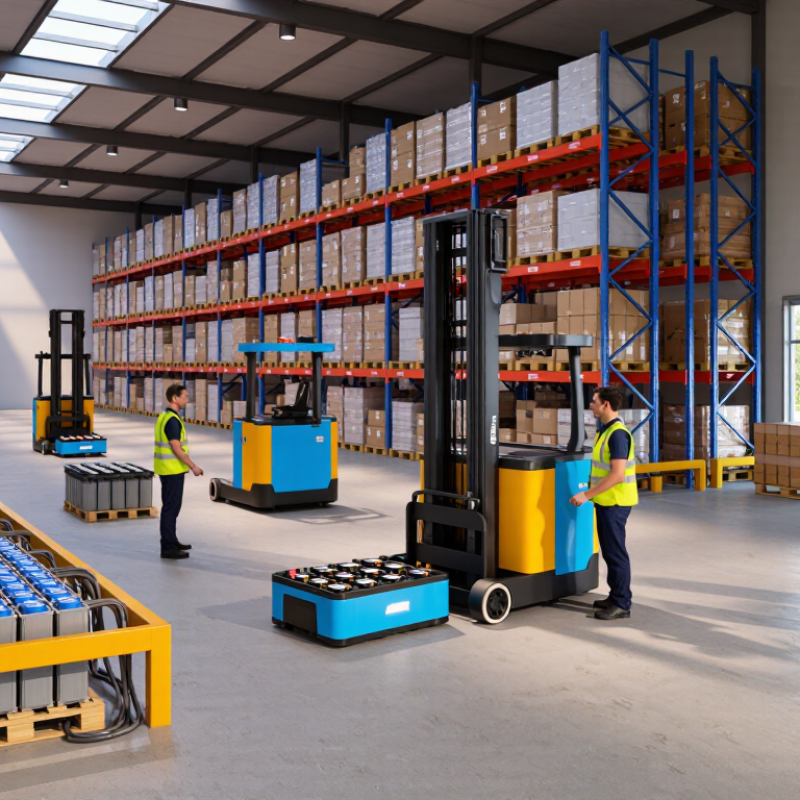
Table of Contents [Hide]
Identify Your Forklift’s Battery Requirements
Start with the forklift’s data plate and operator manual. Record the required voltage, battery dimensions, maximum battery weight, and connector type. These are basic fit checks, not minor details. A battery that is too light may affect counterbalance, while one that is too large may not fit the compartment.
Next, match battery capacity to the workday. Note typical shift length, travel distance, lifting frequency, and time spent waiting or charging. A truck moving pallets across a large warehouse has different needs from one making short trips in a cool loading area. Check the charger’s output and available charging windows, too. Measure twice. Charging habits matter.
Battery chemistry also affects daily routines. Some types may support brief charging breaks, while others require a different charging schedule or maintenance plan. Confirm compatibility with the forklift and charger before selecting a battery; do not rely on appearance or capacity alone. If the truck runs longer than expected, review actual operating records rather than guessing from a busy day. And be honest about the uncertainty: workload changes by season, and one week of observation may not represent the whole year. A qualified technician can verify fit, electrical requirements, and safe handling procedures.