
-
- Products
- Indoor Household Cords
- Appliance Cords
- General Purpose Short-Length Cords
- General Purpose Extension Cords
- Landscape & Decorating Cords
- Bright Color Extension Cords
- Oil-Resistant Extension Cords
- Cold-Flex Extension Cords
- VividFlex Power Cords
- EXTREME All-Weather Cords
- Cord Management
- Task Lights
- Adapters & GFCI Devices
- Where to Buy
- About
- Careers
- Glossary
- Catalog


How to Choose a Portable Metal Tool Box?
Choosing the right Portable Metal Tool Box is less simple than comparing prices online. A reliable box must match your tools, working environment, and carrying habits. Before buying, consider its steel thickness, overall weight, handle comfort, latch strength, and storage layout. A box that looks durable may still feel awkward after a full day of repairs.
Practical experience often reveals details that product photos hide. Measure your longest wrench and tallest power-tool battery first. Check whether the tray leaves enough room for loose screws, tape, and small replacement parts. Smooth edges protect your hands, while a reinforced base helps the box stay stable on a workshop floor or inside a service vehicle. Rust-resistant coatings also matter in damp garages, although no finish remains perfect forever.
Think about daily use.
A trustworthy Portable Metal Tool Box should support safe, organized access without becoming unnecessarily heavy. Professional users may prefer removable trays, deeper compartments, or stronger hinges. Home users might value compact storage and easier lifting. It is easy to overestimate how many tools you need. I have carried a box packed with “essential” items and used only half of them. That mistake made the box heavier, not better.
This guide examines the main features that influence durability, portability, and long-term value. It also considers common weaknesses, including noisy lids, fragile dividers, sharp corners, and handles that loosen over time. No single design suits everyone. Careful comparison, honest measurements, and realistic expectations will lead to a more dependable choice.
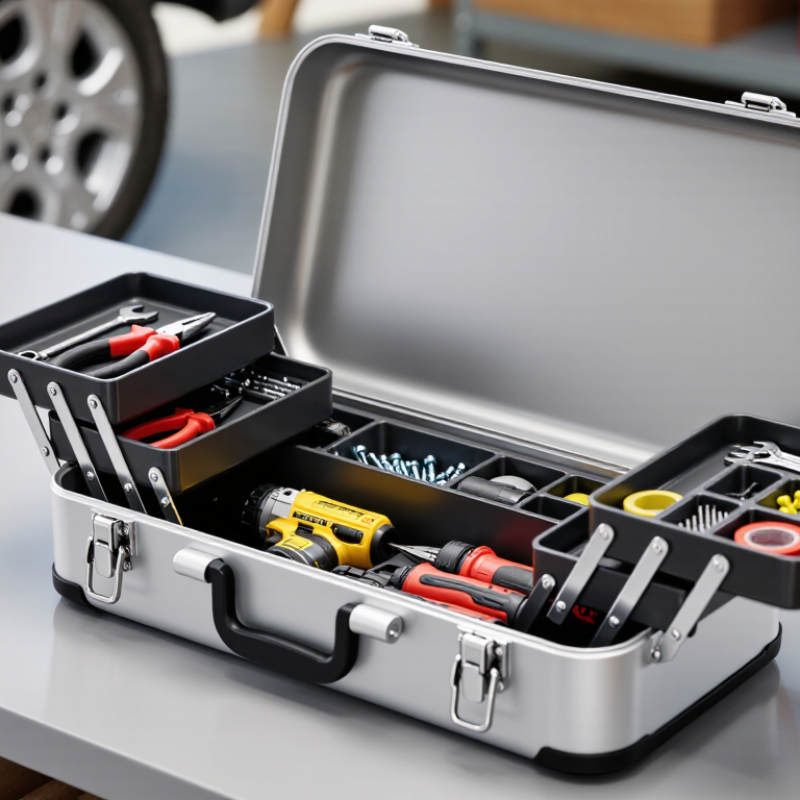
Table of Contents [Hide]
Define Tool Capacity Using Dimensions, Weight, and 20% Expansion Space
How to Choose a Portable Metal Tool Box?
Define capacity before comparing handles, latches, or finishes. Measure the tools you actually carry, including cases, chargers, and small parts. Record length, width, height, and the tallest item. Then calculate occupied volume, but do not trust volume alone. A long wrench can waste space inside a deep box.
Leave at least 20% expansion space for new tools and easier access. If your current tools occupy 8 liters, a 10-liter box keeps roughly 20% free. This is more accurate than simply adding 20%. My first estimate was too optimistic. I forgot the space lost around dividers and corner reinforcements. Interior dimensions matter more than advertised exterior measurements.
Weight deserves equal attention. The NIOSH Revised Lifting Equation uses a 51-pound load constant under ideal lifting conditions, before distance, posture, and frequency adjustments. A portable box should remain comfortably below that limit when carried repeatedly. Liberty Mutual’s 2024 Workplace Safety Index estimated 58.5 billion dollars in serious workplace injury costs, with overexertion among the leading cost categories. That data supports a cautious design choice: calculate the loaded weight, not the empty box weight. Keep dense tools low, and place frequently used items near the opening. For a daily repair kit, a lighter box with 20% spare capacity often works better than a larger, overloaded container. Real work is messier than the spreadsheet.