
-
- Products
- Indoor Household Cords
- Appliance Cords
- General Purpose Short-Length Cords
- General Purpose Extension Cords
- Landscape & Decorating Cords
- Bright Color Extension Cords
- Oil-Resistant Extension Cords
- Cold-Flex Extension Cords
- VividFlex Power Cords
- EXTREME All-Weather Cords
- Cord Management
- Task Lights
- Adapters & GFCI Devices
- Where to Buy
- About
- Careers
- Glossary
- Catalog


How to Choose a Stainless Steel Door Plate
A Stainless Steel Door Plate must do more than match a handle or frame. It faces fingerprints, shoe scuffs, cleaning products, and repeated contact. The right choice depends on where it will be installed, how often it will be cleaned, and the finish you can maintain. Small details matter.
The International Stainless Steel Forum reported 58.4 million tonnes of stainless-steel production worldwide in 2023 in its Stainless Steel in Figures 2024 report. That figure reflects a broad material family, not one interchangeable grade. Materials engineer and author Michael F. McGuire’s work offers a useful selection principle, paraphrased here rather than presented as a direct quotation: “Match the alloy to its environment, not just its appearance.” For a door plate near coastal air or frequent washdowns, corrosion resistance deserves close attention; indoors, appearance and routine cleaning may matter more.
This guide will help compare grade, thickness, surface finish, edge quality, and fixing method. A brushed finish can soften visible scratches, while a mirror finish shows fingerprints readily. Check the plate against the door’s use, not only its sample-card appearance. One caution: supplier descriptions can sound precise while leaving grade or thickness unclear. Ask for those specifications in writing, then compare them with the actual installation conditions.
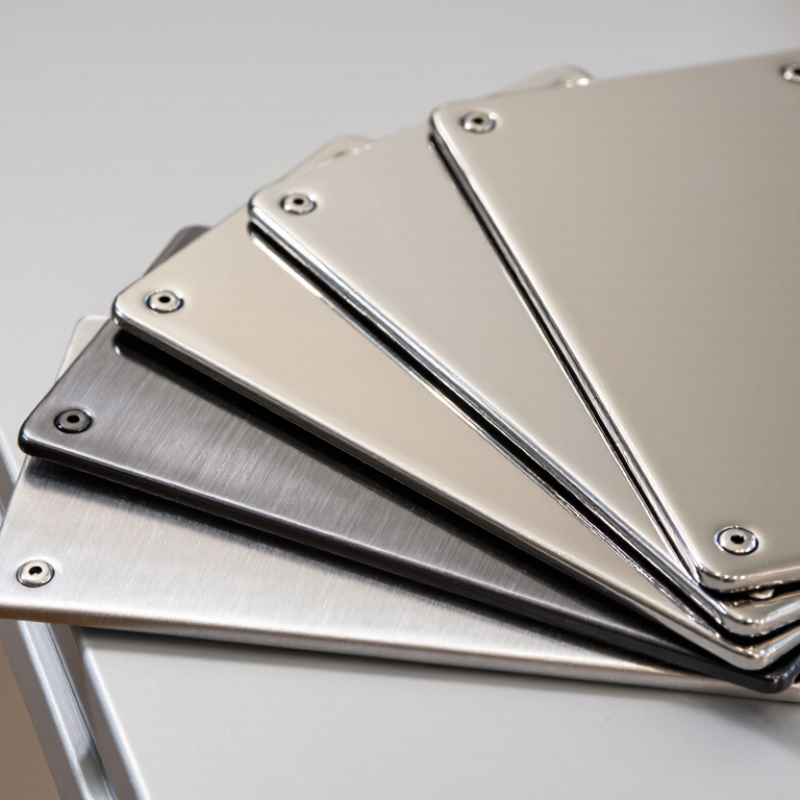
Table of Contents [Hide]
Identify the Door Plate’s Purpose and Installation Conditions
A stainless steel door plate should match the job it needs to do, not just the door’s appearance. A push plate protects the area where hands repeatedly contact the surface. A kick plate takes impacts from shoes, carts, or cleaning equipment. These uses call for different sizes and thicknesses. Measure the contact area, then check how much of the door must remain clear around handles, locks, and hinges. A few millimetres can affect both fit and appearance.
Installation conditions matter just as much. Check whether the door is wood, metal, or a hollow-core construction before choosing screws or adhesive. A plate fixed to a thin or fragile surface may loosen under repeated knocks. Note the door’s swing, nearby walls, and clearance at the floor; an oversized plate can catch or interfere. Damp entryways and frequent cleaning also call for attention to corrosion resistance and edge finish. Stainless steel grades do not all behave identically in wet or salty settings, so confirm suitability with the supplier when exposure is severe. This detail is easy to rush. Even a well-chosen plate can look uneven if the surface is not clean and the layout is not checked before fixing.