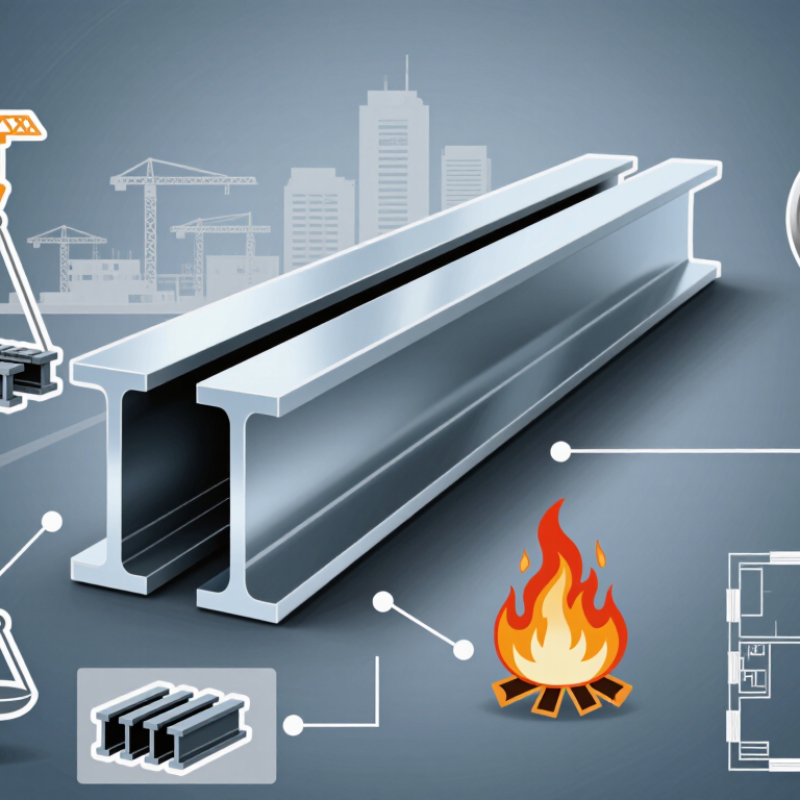
| Structural suitability | Beam type | Universal Beam (UB) with parallel flanges | Confirm that the selected section is listed in the applicable section-property standard and that its second moment of area, elastic modulus, shear area, and mass per metre are available. | Use the final design section from a qualified structural engineer rather than selecting only by nominal depth or weight. |
| Structural suitability | Steel grade | S275 or S355 structural steel under EN 10025-2; S355 has a nominal yield strength of 355 MPa for products up to 16 mm thickness. | Check the material certificate, product thickness, specified yield strength, tensile strength, elongation, and impact-test requirement. | Higher-strength steel may reduce section weight, but it does not automatically solve deflection, vibration, local buckling, connection, or fire-design requirements. |
| Structural suitability | Design actions | Evaluate permanent loads, imposed loads, snow, wind, seismic actions, temperature effects, and accidental actions where applicable. | Compare factored resistance and serviceability results with the governing design code. Check bending, shear, lateral-torsional buckling, bearing, web buckling, and deflection. | Serviceability limits are project-specific; confirm floor vibration and deflection criteria before ordering steel. |
| Section selection | Depth-to-span ratio | Initial screening only: approximately span/15 to span/20 for many simply supported floor or roof beams, subject to loading and design code. | Use this ratio only to create a preliminary shortlist, then verify the complete structural model. | Longer spans, concentrated loads, openings, vibration-sensitive floors, and cantilevers may require a deeper or heavier section. |
| Section selection | Mass and handling | UB mass is normally stated in kilograms per metre; total theoretical mass equals mass per metre multiplied by ordered length. | Allow for rolling tolerances, cut lengths, connection plates, stiffeners, weld metal, protective coating, and packaging. | Heavier sections can increase lifting, transport, connection, and foundation costs even when the steel purchase price is similar. |
| Supplier selection | Technical compliance | Request section standard, steel grade, heat number, dimensional tolerances, surface condition, and inspection documentation. | Verify that the offer references the required standard, product designation, delivery condition, tolerances, and test-document type. | Reject quotations that provide only a nominal size and price without traceability or a clearly stated material standard. |
| Supplier selection | Traceability | Each bundle or piece should be traceable to a heat or cast number and its corresponding material certificate. | Match markings, bundle tags, mill certificates, purchase-order requirements, and delivery quantities before fabrication. | Keep certificates, inspection records, coating records, and installation records in the asset-maintenance file. |
| Supplier selection | Dimensional tolerance | Use the tolerance standard specified by the project; EN 10034 is commonly used for structural steel I and H sections in European specifications. | Inspect depth, flange width, web and flange thickness, straightness, squareness, length, and visible defects. | Tolerance checks are especially important where beams connect to prefabricated components or tight architectural interfaces. |
| Supplier selection | Delivery reliability | Evaluate quoted lead time, available stock, production capacity, cutting capability, transport route, and contingency time. | Compare promised and historical delivery performance, not just the shortest quoted lead time. | For critical members, consider approved equivalent sections or an early-reservation strategy subject to engineering approval. |
| Cost evaluation | Raw steel budget allowance | Indicative 2026 planning allowance: approximately USD 800–1,400 per metric tonne for standard carbon structural sections, before project-specific freight, taxes, fabrication, and coating. | Obtain comparable quotations based on the same grade, section, quantity, cut-length schedule, delivery terms, certification, and payment conditions. | Market prices vary significantly by region, order volume, energy costs, scrap prices, currency, freight, and mill capacity; use a current written quotation for procurement. |
| Cost evaluation | Fabrication allowance | Budget separately for cutting, drilling, copes, end plates, stiffeners, welding, inspection, trial assembly, and shop drawings. | Compare the total fabricated-member price rather than the steel-only price. | A lower material price can be outweighed by additional handling, machining, welding, or connection complexity. |
| Cost evaluation | Transport and lifting | Include loading, legal transport limits, route restrictions, unloading equipment, crane capacity, and site access. | Calculate delivery cost from actual member length, mass, quantity, delivery distance, and unloading requirements. | Splitting a long member may reduce transport difficulty but can increase connection and fabrication costs; obtain engineering approval before modification. |
| Cost evaluation | Protective coating | Common options include shop primer, multi-coat paint systems, and hot-dip galvanizing; the required system depends on exposure and design life. | Specify surface preparation, dry-film thickness, coating materials, repair procedure, inspection method, and warranty conditions. | Coating cost should be compared with expected inspection and recoating costs over the planned service life. |
| Maintenance planning | Initial inspection | Inspect after installation and before concealment, with particular attention to connections, welds, bearing areas, damage, alignment, and coating defects. | Record photographs, locations, defects, corrective actions, and as-built member identification. | Early documentation creates a reliable baseline for future condition assessments. |
| Maintenance planning | Routine visual inspection | Inspect at least annually in normal environments; use shorter intervals where moisture, salt, chemicals, impact, or leakage is present. | Check corrosion, cracking, distortion, coating failure, water traps, loose fasteners, damaged fire protection, and unauthorized alterations. | Inspection frequency should be increased after flooding, fire, vehicle impact, major leakage, or changes in building use. |
| Maintenance planning | Corrosion intervention | Repair coating damage promptly; investigate section loss where corrosion reduces web or flange thickness. | Measure remaining thickness using calibrated equipment and obtain an engineering assessment before strengthening or replacement. | Do not weld, drill, cut, or remove corrosion products from a load-bearing member without an approved repair procedure. |
| Maintenance planning | Fire protection | The required fire-resistance period and protection thickness depend on the building classification, section factor, load level, and fire-design method. | Inspect for cracking, delamination, impact damage, moisture ingress, and gaps around connections and penetrations. | Any change to fire protection can affect the tested or calculated fire-resistance performance and requires technical review. |
| Lifecycle decision | Replacement versus repair | Compare remaining capacity, repair duration, access requirements, temporary works, operational disruption, and future maintenance exposure. | Use condition data and structural calculations rather than visual appearance alone. | A slightly higher initial cost may be preferable when it reduces future access, corrosion, coating, or replacement risk. |
| Procurement checklist | Minimum purchase-order information | Section designation, quantity, cut lengths, steel grade, product standard, tolerance class, delivery condition, certificates, coating system, delivery date, and acceptance criteria. | Make every requirement measurable and require written approval for substitutions. | Maintain a controlled revision of drawings and schedules to prevent incorrect section sizes or duplicated orders. |