
-
- Products
- Indoor Household Cords
- Appliance Cords
- General Purpose Short-Length Cords
- General Purpose Extension Cords
- Landscape & Decorating Cords
- Bright Color Extension Cords
- Oil-Resistant Extension Cords
- Cold-Flex Extension Cords
- VividFlex Power Cords
- EXTREME All-Weather Cords
- Cord Management
- Task Lights
- Adapters & GFCI Devices
- Where to Buy
- About
- Careers
- Glossary
- Catalog


What Is Colorant Masterbatch and How Is It Used?
Colorant Masterbatch is more than concentrated pigment in plastic pellets. It is a controlled formulation containing pigments, additives, and a compatible carrier resin. During extrusion or injection molding, processors add these pellets to natural polymer. The mixture then creates consistent color across bottles, films, pipes, toys, and automotive components.
The scale is significant. PlasticsEurope’s Plastics—The Fast Facts 2024 reports 413.8 million tonnes of global plastics production in 2023. That volume makes color consistency a manufacturing issue, not merely a design preference. Smithers’ The Future of Masterbatch to 2028 also evaluates demand by polymer, application, and region. Its analysis highlights the continuing importance of efficient dosing, dispersion, and material performance. Dr. Wolfgang Huber, a long-standing masterbatch specialist at Gabriel-Chemie, states, “Color is only successful when it remains stable throughout processing.” That principle matters on a factory floor. A poorly dispersed blue pellet can leave streaks, weak spots, or uneven surfaces. Operators may notice the defect only after thousands of parts are molded.
This guide explains how Colorant Masterbatch works, how manufacturers select carrier systems, and why dosage affects shade accuracy. It also considers lightfastness, heat stability, recyclability, and polymer compatibility. Market estimates do not always agree. Definitions and regional coverage vary. That limitation deserves attention. Still, production data and processor experience point in the same direction: reliable color requires formulation science, process control, and testing—not visual judgment alone.
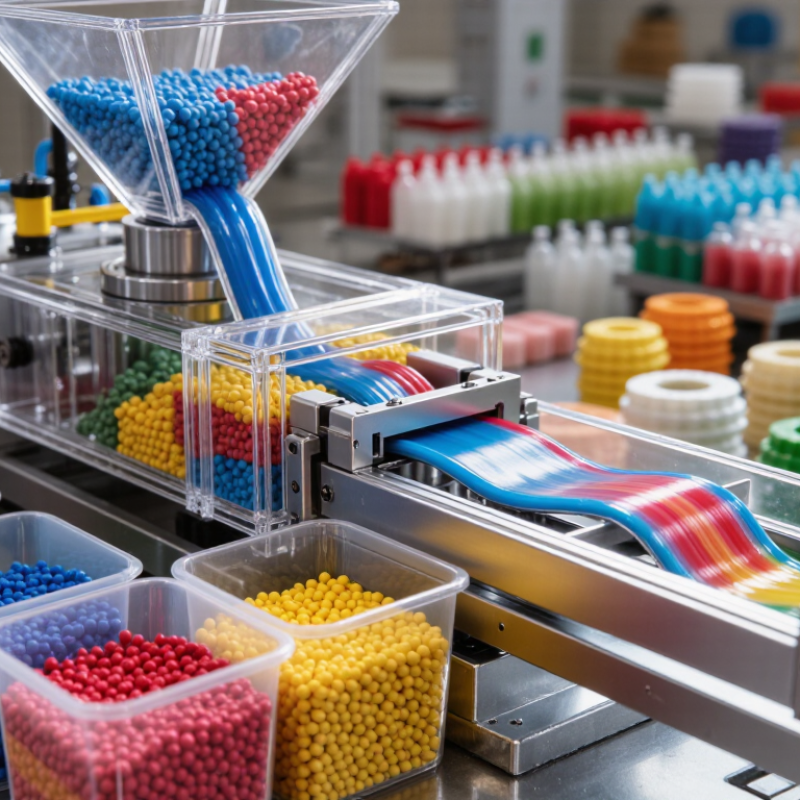
Table of Contents [Hide]
What Is Colorant Masterbatch?
Colorant masterbatch is a concentrated mixture of pigments or dyes and a carrier resin. It usually appears as small, uniform pellets. Manufacturers add these pellets to natural polymer during processing. Heat then disperses the color through the melt.
The carrier should match, or closely suit, the base plastic. A polyethylene carrier often works with polyethylene film, while engineering plastics may need another system. Pigment selection affects shade, opacity, weather resistance, and processing stability. A technician may measure the let-down ratio, such as one part masterbatch to twenty parts resin. The exact ratio depends on the desired color and pigment strength. This calculation matters on an actual production floor.
Colorant masterbatch is used in injection molding, extrusion, blow molding, and some fiber applications. Operators mix it with pellets before feeding the hopper. Good dispersion prevents streaks, specks, and uneven surfaces. Dry storage also helps, especially when moisture-sensitive materials are involved. In my experience, a color that looks correct in a sample plaque can shift inside a thicker product. Lighting, wall thickness, and cooling conditions can change its appearance. It is not a universal solution. Small production trials remain necessary, even when the formulation seems reliable. A batch may still need adjustment.
What Is Colorant Masterbatch and How Is It Used?
| Data Dimension | Typical Information | Practical Significance |
|---|---|---|
| Definition | A concentrated mixture of pigments or dyes dispersed in a polymer carrier and formed into pellets. | It provides a controlled and convenient way to add color during plastic processing. |
| Main Components | Colorant, carrier resin, dispersing or processing additives, and, where required, stabilizers. | The carrier and additives influence dispersion, compatibility, surface appearance, and processing behavior. |
| Common Colorants | Organic pigments, inorganic pigments, carbon black, titanium dioxide, and selected soluble dyes. | The choice depends on the required shade, opacity, weatherability, heat resistance, and regulatory conditions. |
| Typical Colorant Loading | Often approximately 10%–70% by mass, depending on pigment type, shade strength, and masterbatch design. | Higher loading can reduce the amount of masterbatch required, but it must still provide uniform dispersion. |
| Typical Addition Rate | Commonly about 1%–5% of the total polymer mix; exact dosage is determined by the target color and opacity. | The recommended let-down ratio should be confirmed through laboratory or production trials. |
| Carrier Compatibility | The carrier should be compatible with the base polymer, such as polyethylene, polypropylene, polystyrene, ABS, PET, or polyamide. | Poor compatibility may cause streaks, specks, uneven color, weak mechanical performance, or processing instability. |
| Processing Methods | Injection molding, extrusion, blow molding, film production, rotational molding, and fiber spinning. | The masterbatch must be selected for the temperature, residence time, shear level, and equipment used. |
| Mixing Procedure | Meter the masterbatch into the base resin, blend uniformly, and feed the mixture into the processing machine. | Accurate dosing and consistent mixing help prevent shade variation between production batches. |
| Key Performance Properties | Color strength, dispersion, opacity, heat resistance, lightfastness, weather resistance, migration resistance, and moisture level. | These properties determine whether the colored plastic remains uniform and stable during processing and service. |
| Advantages | Cleaner handling than loose pigments, accurate dosing, reduced dust, improved repeatability, and easier color changeover. | These benefits can improve production efficiency and help maintain consistent product appearance. |
| Potential Limitations | Additional material cost, possible carrier incompatibility, dosing errors, and the need for drying with moisture-sensitive polymers. | Material selection, storage, and process control are essential for reliable results. |
| Quality Checks | Color difference, moisture content, melt flow behavior, pigment dispersion, heat stability, and pellet uniformity. | Routine testing supports stable color matching and reduces defects such as streaks, spots, and color drift. |
| Typical Applications | Packaging films, containers, household products, automotive components, electrical parts, pipes, sheets, fibers, and consumer goods. | The appropriate formulation depends on the end-use requirements, polymer type, processing method, and regulatory environment. |