
-
- Products
- Indoor Household Cords
- Appliance Cords
- General Purpose Short-Length Cords
- General Purpose Extension Cords
- Landscape & Decorating Cords
- Bright Color Extension Cords
- Oil-Resistant Extension Cords
- Cold-Flex Extension Cords
- VividFlex Power Cords
- EXTREME All-Weather Cords
- Cord Management
- Task Lights
- Adapters & GFCI Devices
- Where to Buy
- About
- Careers
- Glossary
- Catalog


What Is a Data Centre PDU and How Does It Work?
A Data Centre Pdu is the controlled gateway between a facility’s power infrastructure and its servers. It distributes electricity through monitored outlets, rack-mounted sockets, or busway connections. It can also measure voltage, current, energy use, and temperature. Some models allow remote switching and alert administrators before a circuit becomes overloaded.
Neil Rasmussen, founder of APC and a respected data centre infrastructure expert, has described a data centre as “a power plant with computers in it.” His observation explains why the Data Centre Pdu matters. Reliable computing depends on reliable power delivery. A PDU does not generate electricity. Instead, it manages how electricity reaches servers, storage systems, and network equipment.
Inside a rack, the PDU may receive power from one or two upstream sources. It then divides that supply across several devices. Basic units provide distribution only. Metered models show electrical consumption locally. Intelligent versions send data to management software and support remote outlet control.
The details matter.
A loose connection can create heat. An uneven load can trip a breaker. A failed monitoring sensor can also mislead operators. That last risk deserves more attention than it usually receives.
Choosing a PDU requires more than checking the outlet count. Engineers must compare voltage, phase configuration, plug types, circuit capacity, rack dimensions, redundancy, and monitoring features. They should also review real operating conditions, not only manufacturer ratings.
This guide explains what a Data Centre Pdu does, how it works, and where its limits appear. It also considers practical installation choices, maintenance concerns, and the small decisions that protect uptime.
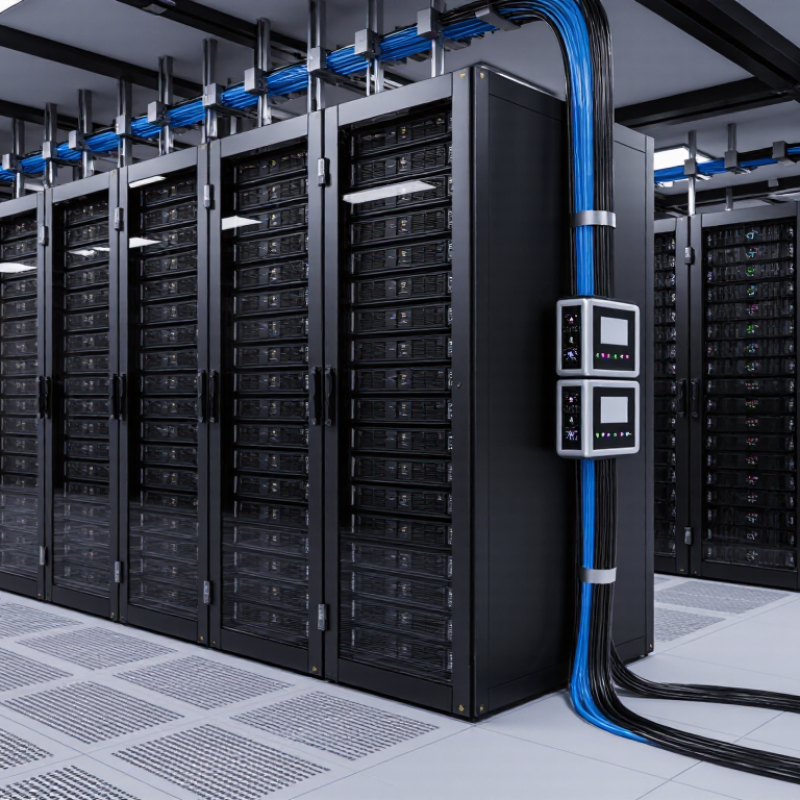
Table of Contents [Hide]
Data Centre PDU Basics: IEC 60320 Outlets and 208–230 V Rack Power
A data centre PDU distributes electrical power from one rack-level input to several servers and networking devices.
It usually mounts vertically or horizontally inside a cabinet. The input cable connects to a facility circuit, while IEC 60320 outlets feed equipment through standard power cords. Common outlet types include C13 for general servers and C19 for higher-current equipment.
In a 208–230 V rack, the PDU delivers voltage suited to modern data centre hardware.
Higher voltage can reduce current for the same load, helping limit cable heating and distribution losses.
However, voltage depends on the facility’s electrical design.
Some systems provide 208 V phase-to-phase, while others provide 230 V phase-to-neutral. A qualified electrician should verify the supply before installation.
The PDU may include circuit breakers, overload protection, metering, and remote monitoring. Basic models show total current locally. Intelligent models can report voltage, power, temperature, and outlet status through a management network.
In practice, I have seen teams focus on outlet count and overlook phase balance. That mistake can leave one circuit heavily loaded while another remains underused.
Check plug compatibility, circuit capacity, connector ratings, and cable length together. Small details matter. A C19 outlet alone does not guarantee that every connected device is safe at maximum load. Load measurements should also be reviewed during normal operation and maintenance periods, when cooling and server demand may change.