
-
- Products
- Indoor Household Cords
- Appliance Cords
- General Purpose Short-Length Cords
- General Purpose Extension Cords
- Landscape & Decorating Cords
- Bright Color Extension Cords
- Oil-Resistant Extension Cords
- Cold-Flex Extension Cords
- VividFlex Power Cords
- EXTREME All-Weather Cords
- Cord Management
- Task Lights
- Adapters & GFCI Devices
- Where to Buy
- About
- Careers
- Glossary
- Catalog


What Is an Electric Gate Valve and How Does It Work?
An Electric Gate Valve controls fluid flow by lifting or lowering a solid gate inside the valve body. Unlike a manual handwheel, its electric actuator converts motor rotation into precise stem movement. The gate travels vertically, leaving the pipeline fully open or tightly closed. It is not designed for frequent throttling. That distinction matters.
The International Energy Agency reports that electric motor systems consume more than half of global electricity. This places efficiency, control, and maintenance under growing industrial scrutiny. The U.S. Department of Energy also identifies motor-driven equipment as a major share of industrial electricity use. In practical terms, an inefficient actuator can waste energy every time a valve cycles. Small losses become expensive across hundreds of operating cycles.
Industry standards provide a safer technical foundation. API 600 addresses steel gate valves, while ASME B16.34 covers pressure-temperature ratings and valve construction. ISO 5210 supports actuator attachment and interface requirements. These references help engineers select suitable equipment for water treatment, power generation, oil and gas, and process plants. Yet standards do not remove every risk. Installation errors still happen.
A typical system includes the valve body, gate, stem, electric actuator, limit switches, and control wiring. When a signal arrives, the actuator drives the stem until a preset limit is reached. Torque protection can stop movement when resistance becomes abnormal. The sound may change. The actuator may also overheat.
This article explains how an Electric Gate Valve works, where it performs well, and where its limitations deserve honest attention. Some applications appear simple, but real service conditions often disagree.
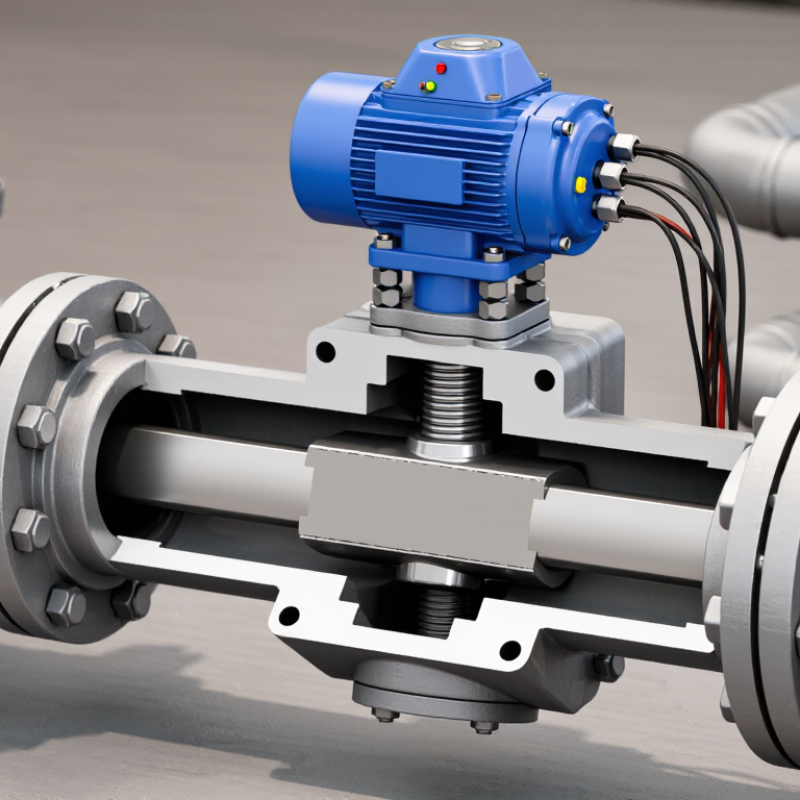
Table of Contents [Hide]
Electric Gate Valve: Definition and Core Purpose
An electric gate valve is an isolation device operated by an electric actuator. Its core purpose is simple: stop or permit fluid flow through a pipeline. When energized, the motor rotates a stem. The stem moves a wedge or slab gate vertically across the passage. A fully raised gate leaves a nearly unobstructed flow path. A fully lowered gate closes the line.
It is not normally a throttling valve. Partial opening can create turbulence, vibration, and seat damage. This distinction matters in water treatment, power generation, and process facilities. The UN World Water Development Report 2024 states that agriculture accounts for about 70% of global freshwater withdrawals. Reliable isolation therefore supports safer maintenance and controlled water distribution. The IEA’s Energy Efficiency 2023 report also identifies industry as responsible for roughly 37% of global final energy consumption. Reducing leakage and avoiding unnecessary pumping remain practical priorities.
An actuator may include limit switches, torque protection, and position feedback. These features help operators confirm whether the gate is open or closed from a control room. Proper sizing requires attention to valve pressure class, stem load, cycle frequency, and power supply. Standards such as ISO 5210 help define actuator attachment and output requirements. Field experience shows that installation errors still occur, especially when flow direction and travel limits receive little attention. Remote operation is useful, but it does not replace inspection. A valve can report “closed” while debris prevents tight sealing. That uncomfortable possibility deserves routine testing.