
-
- Products
- Indoor Household Cords
- Appliance Cords
- General Purpose Short-Length Cords
- General Purpose Extension Cords
- Landscape & Decorating Cords
- Bright Color Extension Cords
- Oil-Resistant Extension Cords
- Cold-Flex Extension Cords
- VividFlex Power Cords
- EXTREME All-Weather Cords
- Cord Management
- Task Lights
- Adapters & GFCI Devices
- Where to Buy
- About
- Careers
- Glossary
- Catalog


How to Choose the Right U Channel Steel for Your Project
Choosing the right U Channel Steel begins with more than comparing price per metre. The section must match the project’s load, span, connection method, environment, and applicable standard. A channel supporting a warehouse beam faces different demands from one used as a light equipment frame. Small errors matter.
The World Steel Association reported approximately 1.89 billion tonnes of crude steel production in 2023, showing the scale and maturity of the global steel supply chain. However, high production volume does not guarantee suitable material for every application. ASTM A6/A6M provides general requirements for structural steel shapes, including dimensional tolerances and inspection expectations. ASTM A36/A36M remains widely specified, with a minimum yield strength of 36 ksi for applicable products, while EN 10025 grades such as S235 and S355 serve many European projects. Always verify the actual mill certificate.
Experienced engineers examine channel depth, flange width, thickness, weight, and section properties before approval. They also consider buckling, weldability, galvanizing compatibility, and local corrosion exposure. A coastal support may need galvanizing or a protective coating, not merely a thicker wall. An indoor frame may not need that expense. It depends.
Supplier quality is equally important. Confirm heat numbers, test certificates, straightness, surface condition, and traceability. The American Institute of Steel Construction emphasizes documented design and fabrication practices through its specifications and quality programs. Yet standards cannot replace engineering judgment. A catalogue selection can appear efficient and still perform poorly after unexpected vibration, eccentric loading, or poor drainage. This guide explains how to compare U Channel Steel rationally, while acknowledging an uncomfortable truth: the cheapest section is rarely the cheapest complete solution.
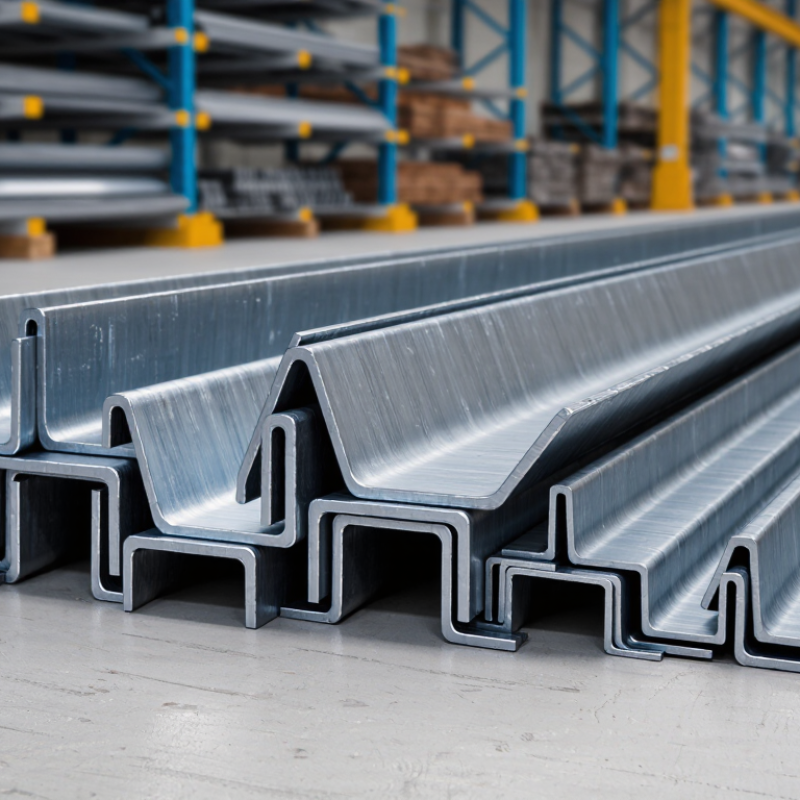
Table of Contents [Hide]
Define U Channel Steel and Its Common Project Applications
U channel steel is a rolled steel section with one web and two parallel flanges. Its cross-section resembles the letter U. The web carries much of the vertical load, while the flanges improve stiffness and connection space. It comes in different depths, widths, thicknesses, and steel grades. These dimensions affect strength, weight, corrosion resistance, and fabrication cost. It is not merely decorative metal.
In building projects, engineers use U channel steel for secondary beams, edge supports, frames, and equipment bases. It also forms door headers, trench covers, cable supports, and protective guards. In workshops, channel sections can create machine stands or guide rails. They are also useful for trailers and light structural frames. I have seen poorly selected channels twist when unsupported spans were underestimated. That problem often begins with a convenient size choice.
Before choosing a section, check the span, load direction, connection method, and exposure conditions. A thicker channel is not automatically better. It may add weight and complicate welding. Review engineering tables and qualified calculations for critical structures. For outdoor use, specify suitable protection and inspect cut edges after fabrication. Small details matter. Recheck actual site clearances, because drawings can hide pipes, bolts, or uneven surfaces.