
-
- Products
- Indoor Household Cords
- Appliance Cords
- General Purpose Short-Length Cords
- General Purpose Extension Cords
- Landscape & Decorating Cords
- Bright Color Extension Cords
- Oil-Resistant Extension Cords
- Cold-Flex Extension Cords
- VividFlex Power Cords
- EXTREME All-Weather Cords
- Cord Management
- Task Lights
- Adapters & GFCI Devices
- Where to Buy
- About
- Careers
- Glossary
- Catalog


7 Tips for Choosing the Right Cross Slide Table?
Choosing the right Cross Slide Table is rarely a simple matter of comparing travel lengths. A compact table may look impressive, yet flex under a modest cutting load. Another model may offer excellent precision but lack the adjustment range your fixture requires.
This guide, “7 Tips for Choosing the Right Cross Slide Table,” focuses on practical selection decisions. It examines load capacity, travel distance, rigidity, backlash, mounting patterns, operating environment, and repeatability. Each detail matters. Small errors become expensive.
W. Edwards Deming, a respected quality expert, said, “In God we trust; all others must bring data.” That principle applies directly here. Check measured accuracy, not only catalog claims. Request test results when possible. Compare radial and axial loads separately. Confirm whether stated precision applies before or after installation.
In real workshops, I have seen buyers choose a table because its handwheel felt smooth. Later, the table developed play during drilling. That choice looked reasonable. It was not fully evaluated.
A reliable Cross Slide Table should match the machine, workpiece, tooling, and operator. Consider steel or aluminum construction, lead-screw design, lubrication access, and T-slot compatibility. Think about dust, coolant, and daily adjustment frequency.
Some requirements remain uncertain. You may not know the final fixture size today. Leave practical adjustment room, but avoid buying excessive capacity without purpose. Larger tables often add weight and cost.
The following seven tips will help you question specifications carefully, identify hidden compromises, and select a table that performs consistently in real working conditions.
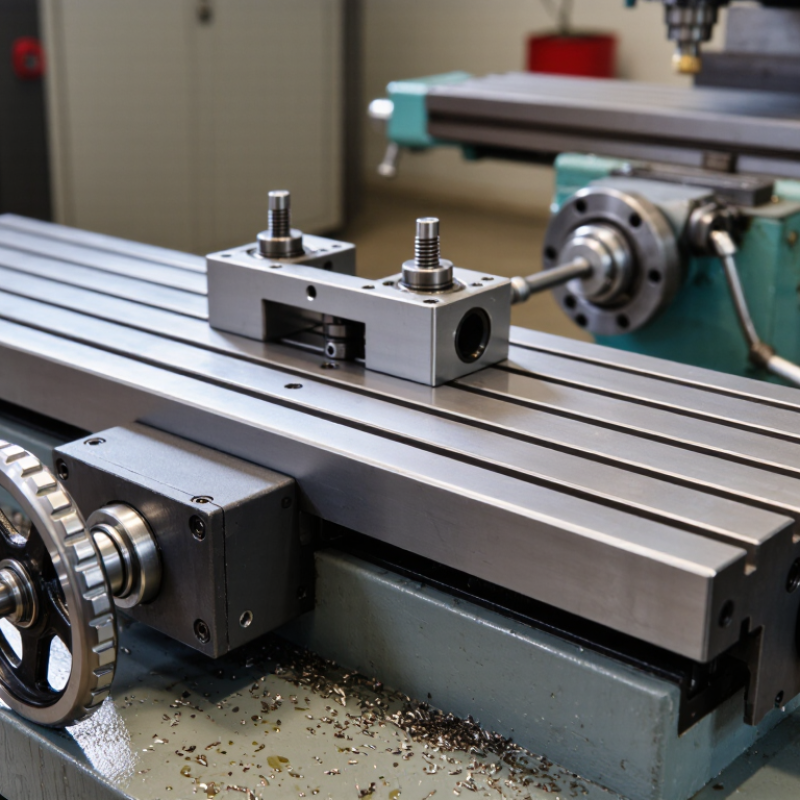
Table of Contents [Hide]
Define Cross Slide Table Types, Axes, and Typical Travel Ranges
7 Tips for Choosing the Right Cross Slide Table
Define Cross Slide Table Types, Axes, and Typical Travel Ranges
A cross slide table provides controlled movement along two perpendicular axes. Compact manual tables often use dovetail slides, while ball-bearing designs support smoother, lighter motion. Some models add a vertical Z-axis, creating XYZ positioning.
Tip 1: Identify the required axes before comparing size or price. A two-axis table may suit drilling and inspection. A three-axis table offers greater flexibility, but it also increases height and setup complexity.
Travel range depends strongly on table size. Small precision tables commonly offer 25–50 mm per axis. Medium tables often provide 75–150 mm. Larger industrial versions may reach 200–300 mm, though rigidity can decrease near maximum extension.
Tip 2: Measure the actual working envelope, not only the table’s travel. A 100 mm range may become impractical when clamps, tooling, and safety clearance consume space. This is easy to overlook.
Tip 3: Match the slide type to the load and adjustment speed. Dovetail slides usually resist vibration well and feel stable under heavier loads. Ball-bearing slides can move more freely, but contamination may affect smoothness.
Tip 4: Check axis backlash, lead screw pitch, and locking points. Fine adjustment matters during alignment. I would also test the handwheel position in the real workspace.
Specifications can look excellent, yet an awkward handle makes repeated adjustments tiring. Travel figures are useful, but they are not the whole decision.