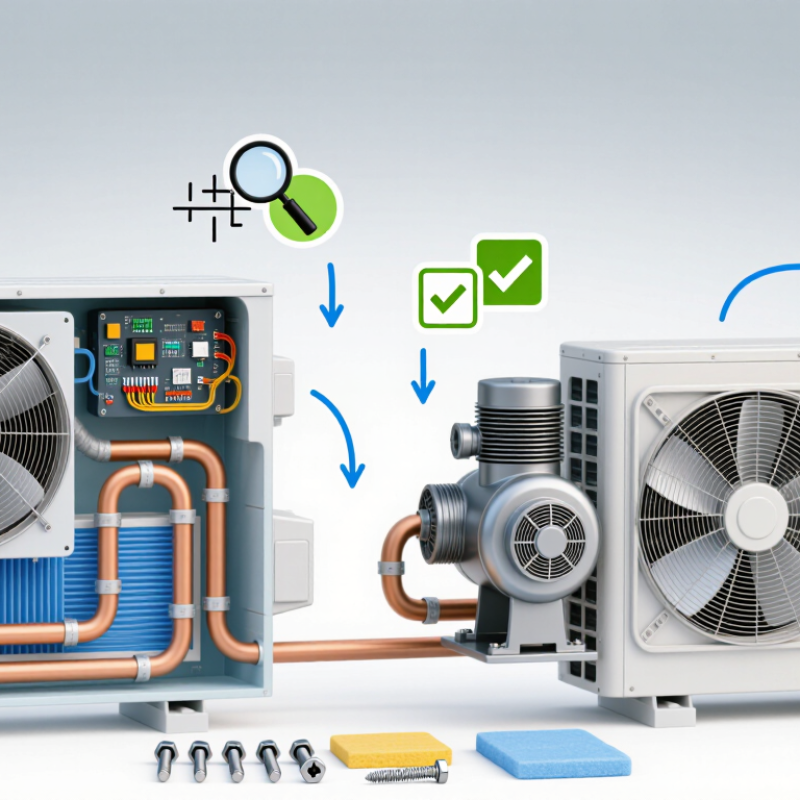
| Copper Tubes and Fittings | Refrigeration-grade copper tubing is commonly supplied in soft coils or hard straight lengths. Common sizes include approximately 6.35 mm, 9.52 mm, 12.70 mm and 15.88 mm outside diameter. | Match the liquid and suction-line diameters, wall thickness, connection type, refrigerant system, working pressure and installation method. | Check dimensional tolerance, tube cleanliness, internal oxidation, surface defects, flare quality, pressure resistance and leak-test results. The material should be suitable for refrigeration service. | Material certificate, dimensional inspection report, pressure or leak-test report and packaging photos. | Evaluate traceability of raw material, consistency between batches, moisture-proof packaging and the supplier's ability to provide cut-to-length or customized fittings. |
| Compressors | Rotary compressors are widely used in small split and residential systems, while scroll compressors are commonly used in larger-capacity applications. Capacity depends on displacement, refrigerant and operating conditions. | Confirm refrigerant type, rated voltage, frequency, phase, cooling capacity, oil type, starting method, mounting dimensions, discharge temperature and operating envelope. | Review insulation resistance, winding resistance, vibration, noise, starting current, cooling capacity, power input and high-temperature operating performance. | Performance test report, electrical safety report, operating-envelope data, dimensional drawing and warranty terms. | Prefer suppliers with controlled testing facilities, serial-number traceability, stable packaging and documented handling procedures for oil-filled components. |
| Expansion Valves and Capillary Tubes | Electronic expansion valves provide variable refrigerant flow control. Capillary tubes provide fixed flow restriction and are generally used in simpler, fixed-capacity systems. | Match valve capacity, port size, coil voltage, control signal, refrigerant, pressure range and system load. Capillary selection depends on tube diameter, length, refrigerant and design conditions. | Check flow repeatability, response time, valve shut-off performance, coil resistance, dimensional accuracy and cleanliness of the internal passage. | Flow-test data, electrical specifications, control protocol information, dimensional drawings and sample approval records. | Assess engineering support, availability of calibration data and the supplier's ability to provide matched components rather than generic parts with uncertain flow characteristics. |
| Heat Exchanger Coils | Evaporator and condenser coils typically use copper tubes with aluminum fins. Important design variables include tube diameter, fin spacing, coil rows, face area and circuit arrangement. | Match cooling or heating capacity, airflow, refrigerant, working pressure, cabinet dimensions, fan position, condensate drainage and connection locations. | Inspect fin uniformity, tube expansion, brazed joints, corrosion protection, air-side pressure drop, refrigerant leakage and condensate drainage performance. | Coil drawing, capacity test data, leak-test record, fin and tube material information and corrosion-test data where required. | Review tooling control, brazing quality, fin-forming accuracy, protective packaging and the supplier's ability to reproduce the approved sample. |
| Fan Motors and Blowers | Common configurations include indoor cross-flow blowers, outdoor axial fans and electronically controlled motors. Rated values vary by voltage, speed, airflow and motor design. | Confirm voltage, frequency, phase, shaft or mounting dimensions, rotation direction, speed-control method, connector type, airflow requirement and noise limit. | Test insulation, locked-rotor protection, current draw, speed stability, vibration, bearing noise, temperature rise and airflow at the intended static pressure. | Motor data sheet, wiring diagram, airflow-performance curve, safety test report and vibration or noise test results. | Check production consistency, motor balancing equipment, incoming-material controls and protection against shaft or bearing damage during transportation. |
| Printed Circuit Boards and Controllers | Control boards may manage compressor operation, fan speed, sensors, defrost functions, communication and protection logic. Inverter systems require control electronics compatible with the power module and motor. | Match the exact unit model, firmware, connector layout, sensor curve, supply voltage, communication protocol, power rating and safety functions. | Inspect component placement, solder quality, conformal coating where specified, insulation spacing, surge protection, temperature testing and functional-test coverage. | Circuit diagram, firmware or parameter record, functional-test report, component approval list and electrostatic-discharge handling procedure. | Evaluate engineering change control, firmware version management, after-sales troubleshooting support and protection of design files and technical information. |
| Capacitors | AC motor-run capacitors are selected by capacitance, rated voltage, frequency, temperature range and duty cycle. Common applications include compressor and fan motors. | Match capacitance tolerance, rated voltage, terminal style, can dimensions, temperature class and the motor manufacturer's electrical requirements. | Verify capacitance, dissipation factor, insulation resistance, self-healing behavior, pressure-disconnect protection and endurance at elevated temperature. | Capacitance test report, safety certification applicable to the destination market, endurance data and lot traceability. | Confirm dielectric-material consistency, date-code control, moisture protection and clear separation of approved and non-approved production lots. |
| Refrigerant Filters and Filter Driers | Filter driers remove moisture, acid and particulate contamination from refrigeration circuits. Selection depends on refrigerant, system capacity, connection size and required moisture capacity. | Match refrigerant compatibility, flow direction, connection type, pressure rating, moisture capacity and installation position. | Check pressure drop, shell integrity, desiccant containment, particle filtration, internal cleanliness and resistance to vibration and temperature cycling. | Pressure-rating information, flow data, moisture-capacity data, leak-test report and material declaration. | Assess sealing quality, contamination control, end-cap protection and shelf-life management for desiccant components. |
| Air Filters | Common air filters include washable mesh, pleated synthetic media and other application-specific filter materials. Performance is determined by filtration efficiency, airflow resistance and dust-holding capacity. | Match filter dimensions, frame design, airflow direction, target particle size, pressure drop, cleaning method and indoor-air-quality requirements. | Measure dimensions, media uniformity, airflow resistance, filtration performance, frame strength, odor characteristics and resistance to moisture or repeated washing where applicable. | Filtration test report, pressure-drop curve, material safety information and dimensional inspection report. | Review raw-material traceability, cleanliness of the production area, cutting accuracy and packaging that prevents deformation or contamination. |
| Sensors and Thermistors | Temperature sensors commonly use negative-temperature-coefficient thermistors. Typical resistance values and accuracy depend on the control design and sensing location. | Match resistance-temperature curve, tolerance, probe dimensions, cable length, connector, operating range and controller software settings. | Check resistance at defined temperatures, response time, insulation, waterproofing, cable pull strength and long-term drift. | Resistance-temperature curve, calibration report, connector drawing, environmental test data and lot identification. | Favor suppliers with calibrated test equipment, controlled crimping processes and documented sensor matching procedures. |
| Remote Controls and Display Modules | Components may include infrared remote controls, wired controllers, display panels and receiver boards. Functions vary according to system architecture. | Match communication method, code or protocol, display layout, connector, operating voltage, language requirements and supported functions. | Verify transmission range, button reliability, display readability, connector durability, battery leakage protection and operation across the specified temperature range. | Functional test record, user-interface specification, dimensional drawing, electrical data and packaging specification. | Evaluate firmware or code control, tooling stability, labeling accuracy and the supplier's capacity for replacement-unit continuity. |
| Electrical Contactors and Relays | Contactors and relays switch compressor, fan, heater and auxiliary circuits. Selection depends on coil voltage, contact arrangement, load type and switching frequency. | Match coil voltage, contact rating, motor or resistive load, number of poles, mounting dimensions, terminal arrangement and applicable electrical requirements. | Test contact resistance, dielectric strength, insulation resistance, pickup and dropout voltage, temperature rise and electrical endurance. | Electrical ratings, endurance-test data, safety test report, wiring diagram and incoming-inspection criteria. | Check contact-material consistency, lot traceability, terminal torque control and protection from moisture and dust during shipment. |