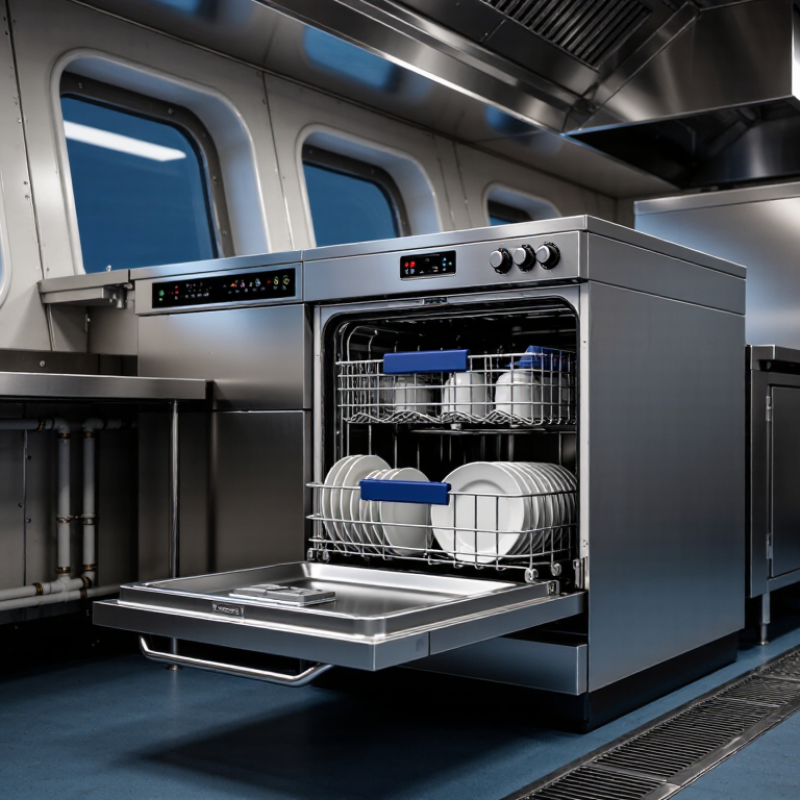
| Primary Application | Commercial galleys, offshore vessels, passenger ships, cargo vessels, research vessels, and naval support vessels. | Equipment must match the vessel’s crew size, meal volume, galley layout, and operating schedule. | Confirm the intended vessel type, daily meal periods, available installation space, and expected dishware mix. |
| Machine Configuration | Common configurations include undercounter, hood-type, pass-through, rack conveyor, and flight-type systems. | Different configurations support different galley footprints and washing volumes. | Measure doorways, service corridors, deck access, ceiling height, and required loading direction before selection. |
| Typical Throughput | Undercounter units: approximately 30–60 racks per hour; hood-type units: approximately 40–80 racks per hour; conveyor systems: commonly 100 racks per hour or more. | Throughput affects how quickly the galley can return clean tableware to service during peak meal periods. | Compare the rated capacity with actual peak demand rather than relying only on the maximum published figure. |
| Wash Cycle Time | Many commercial marine units operate with wash cycles of approximately 60–120 seconds, depending on the selected program and soil level. | Short cycles help reduce dishware shortages and limit galley workflow interruptions. | Check standard, intensive, economy, and heat-sensitive programs, including the actual duration of each cycle. |
| Wash Temperature | Commercial warewashing systems commonly use wash water in the approximate range of 55–65°C. | A suitable wash temperature supports grease removal while helping protect tableware and wash-system components. | Verify the temperature range recommended by the detergent supplier and the equipment manufacturer. |
| Final Rinse Temperature | High-temperature sanitizing models commonly use a final rinse of approximately 80–85°C, subject to local regulations and equipment design. | Final-rinse temperature is an important sanitation-control parameter for food-service operations. | Confirm the required sanitation method, rinse-temperature monitoring, booster-heater capacity, and local maritime or catering rules. |
| Water Consumption | Typical fresh-water consumption may range from approximately 2–4 liters per rack for efficient commercial systems, while larger or older designs may use more. | Lower water demand helps reduce freshwater production, storage, heating, and wastewater loads on board. | Request water consumption per rack or per cycle under defined test conditions, not only an annual estimate. |
| Electrical Supply | Marine installations may be configured for common shipboard supplies such as 220–240 V or 380–440 V, with 50 Hz or 60 Hz operation depending on the vessel. | Electrical compatibility is essential because shipboard voltage, frequency, phase, and short-circuit conditions vary. | Match voltage, phase, frequency, rated current, breaker requirements, and available shore-power arrangements to the vessel specification. |
| Heating Method | Available options generally include electric tank heating, electric booster heating, and external hot-water supply. | The heating method influences peak electrical demand, installation complexity, and recovery time between cycles. | Compare total connected load, hot-water availability, heating recovery rate, insulation, and energy-management requirements. |
| Construction Materials | Food-contact and exposed wet-area components are commonly manufactured from corrosion-resistant stainless steel, often including AISI 304; AISI 316 may be selected for more aggressive marine environments. | Corrosion resistance improves service life in humid, salty, and frequently washed shipboard conditions. | Verify the stainless-steel grade used for the tank, panels, wash arms, fasteners, and other corrosion-prone components. |
| Marine-Suitable Design | Useful features include reinforced frames, secure panel fasteners, adjustable leveling feet, compact service access, protected controls, and provisions for vibration management. | Ships experience vibration, movement, limited access, and space constraints that are uncommon in ordinary land-based kitchens. | Ask for installation drawings, mounting recommendations, vibration considerations, and equipment operating limits. |
| Detergent and Rinse-Aid System | Many systems support automatic dosing pumps for liquid detergent and rinse aid, with adjustable dosing settings. | Automatic dosing improves consistency and helps prevent excessive chemical use or poor washing results. | Confirm chemical compatibility, pump calibration, hose routing, container access, and availability of replacement parts. |
| Filtration and Soil Management | Common features include removable tank filters, scrap screens, pump protection filters, and wash-water recirculation systems. | Effective filtration protects pumps and wash arms while maintaining cleaning performance during repeated cycles. | Check filter access, cleaning frequency, spare-filter availability, and procedures for heavy food-soil conditions. |
| Noise and Working Environment | Commercial dishwashers are often designed for enclosed galley operation, with noise levels depending on the model, enclosure, pump, and installation method. | Lower noise improves communication and working comfort in compact crew and passenger areas. | Request a measured sound-pressure value in dB(A), including the distance and operating condition used for testing. |
| Drainage Requirements | Drain systems may use gravity drainage or a built-in drain pump, depending on the machine position and vessel plumbing layout. | Correct drainage prevents standing water, odor, backflow, and interruptions to galley operations. | Confirm drain height, drain diameter, pump capacity, backflow prevention, and compatibility with the vessel’s wastewater system. |
| Control and Monitoring | Modern units may provide digital temperature displays, cycle indicators, fault codes, low-chemical alerts, and programmable operating modes. | Clear monitoring supports sanitation records, troubleshooting, and consistent daily operation. | Evaluate display readability, password protection, data logging, alarm functions, and ease of use with wet gloves. |
| Cleaning and Maintenance | Preferred features include tool-free filter removal, rounded internal corners, removable wash arms, accessible tanks, and automatic self-cleaning programs. | Simple maintenance reduces downtime and helps maintain hygiene in continuous shipboard service. | Request daily, weekly, and periodic maintenance schedules together with estimated service time and consumable requirements. |
| Safety Provisions | Typical provisions include door or hood interlocks, over-temperature protection, emergency stop arrangements where applicable, and electrical protection suitable for the installation. | Safety controls reduce risks from hot water, steam, moving components, and electrical faults. | Review the risk assessment, protective devices, grounding requirements, emergency procedures, and installation clearances. |
| Wastewater and Environmental Considerations | Efficient operation can reduce freshwater use, detergent consumption, energy demand, and the volume of wash-water discharged from the galley. | Resource efficiency is particularly valuable on vessels with limited freshwater-generation and wastewater-treatment capacity. | Request verified water and energy data, chemical-dosing information, and guidance for onboard wastewater handling. |
| Documentation for Global Buyers | Important documents may include technical datasheets, wiring diagrams, plumbing diagrams, spare-parts lists, operation manuals, maintenance instructions, and packing details. | Complete documentation supports installation, vessel approval, crew training, maintenance, and international logistics. | Require English documentation and confirm whether project-specific drawings and certificates can be supplied before shipment. |
| Spare Parts and Service Support | Critical spare parts commonly include heating elements, pumps, thermostats, solenoid valves, door seals, wash arms, filters, dosing pumps, and control components. | Rapid access to parts reduces downtime when the vessel is operating far from the original point of supply. | Check recommended onboard spare-parts kits, lead times, remote technical support, warranty terms, and service coverage. |
| Supplier Qualification Criteria | Relevant evaluation factors include marine installation experience, production quality control, customization capability, documentation quality, testing procedures, and after-sales response. | A technically suitable machine can still create operational risk if the supplier cannot support installation and long-term maintenance. | Compare technical compliance, factory testing, delivery capability, warranty conditions, spare-parts planning, and total cost of ownership. |