
-
- Products
- Indoor Household Cords
- Appliance Cords
- General Purpose Short-Length Cords
- General Purpose Extension Cords
- Landscape & Decorating Cords
- Bright Color Extension Cords
- Oil-Resistant Extension Cords
- Cold-Flex Extension Cords
- VividFlex Power Cords
- EXTREME All-Weather Cords
- Cord Management
- Task Lights
- Adapters & GFCI Devices
- Where to Buy
- About
- Careers
- Glossary
- Catalog


Top EVA Shoe Mould Manufacturers for Global Buyers
Choosing among the top EVA Shoe Mould manufacturers requires more than comparing unit prices. Buyers must examine tooling accuracy, foam compatibility, testing discipline, and after-sales support.
The global footwear market continues to expand. Grand View Research valued it at approximately USD 476 billion in 2023 and expects continued growth through 2030. ResearchAndMarkets also identifies EVA foam as a major material in lightweight footwear and sports products. These figures show strong demand, but they do not guarantee reliable mould production. A beautiful sample can still fail during repeated compression.
Matt Priest, President and CEO of the Footwear Distributors and Retailers of America, has stated, “Visibility is the key to resilience.” That principle applies directly to EVA mould sourcing. Buyers need visible specifications, trial records, material data, and production timelines. A dependable supplier should explain aluminium grades, CNC tolerances, venting design, cooling channels, and expected mould life. Factory photographs help. Measured inspection reports help more.
This guide evaluates manufacturers through practical evidence, not marketing claims. It considers prototype speed, dimensional consistency, technical communication, export experience, and corrective-action procedures. ISO 9001 certification can support confidence, but certification alone proves little. Ask for recent references.
There is no perfect shortlist. Some suppliers offer excellent prices but limited engineering support. Others deliver sophisticated tooling at a higher cost. That trade-off deserves honest review. For global buyers, the best EVA Shoe Mould partner is not always the cheapest factory. It is the manufacturer that repeatedly turns drawings into stable, production-ready soles.
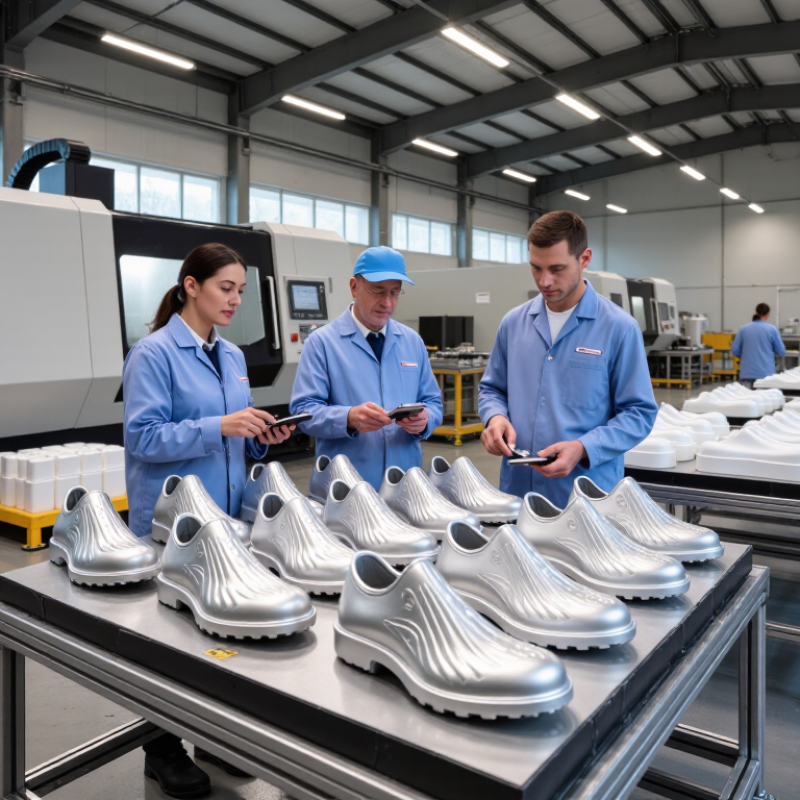
Table of Contents [Hide]
EVA Shoe Moulds: Materials, Features, and Manufacturing Principles
EVA Shoe Moulds: Materials, Features, and Manufacturing Principles
EVA shoe moulds shape lightweight soles, sandals, and midsoles through controlled heat and pressure. Their performance depends on mould material, cavity accuracy, and foam expansion settings. Aluminum moulds offer fast heat transfer and easier handling. Steel moulds provide greater wear resistance for long production runs. Both options require accurate CNC machining and careful surface finishing.
A reliable mould includes balanced cavities, smooth edges, effective vents, and stable alignment. Vents release trapped air during foaming and reduce surface marks. Designers must also allow for EVA expansion and cooling shrinkage. Small errors can change sole dimensions noticeably. In practical production, test samples reveal problems that drawings may hide. No mould is perfect. Even experienced teams may adjust pressure, temperature, or vent positions after testing.
Tips: Check the EVA grade before selecting the mould structure. Confirm expected density, expansion rate, and production volume with the manufacturer. Inspect sample soles for weight, hardness, edge definition, and uneven cell patterns. Keep cavity surfaces clean and apply suitable maintenance after production. A cheaper mould can become expensive when correction work delays delivery. Buyers should request material certificates, dimensional reports, and clear trial records. Good documentation improves reliability, although it cannot replace hands-on inspection.