-
- Products
- Indoor Household Cords
- Appliance Cords
- General Purpose Short-Length Cords
- General Purpose Extension Cords
- Landscape & Decorating Cords
- Bright Color Extension Cords
- Oil-Resistant Extension Cords
- Cold-Flex Extension Cords
- VividFlex Power Cords
- EXTREME All-Weather Cords
- Cord Management
- Task Lights
- Adapters & GFCI Devices
- Where to Buy
- About
- Careers
- Glossary
- Catalog

China Top Hydraulic Rubber Hose Manufacturers?
China’s hydraulic hose sector has become a major sourcing base for construction, mining, agriculture, and industrial equipment. Grand View Research estimated the global hydraulic hose market at approximately USD 1.7 billion in 2023, with continued growth expected through 2030. MarketsandMarkets also projects steady expansion, driven by mobile machinery, replacement demand, and stricter equipment maintenance requirements.
The numbers matter, but they do not tell the whole story. A reliable Hydraulic Rubber Hose manufacturer must control rubber formulation, reinforcement quality, crimp accuracy, and batch traceability. ISO 18752, SAE J517, and EN 853 are useful reference points, yet certification alone cannot replace factory audits. Look closely. Ask for impulse-test records, temperature ratings, aging results, and actual production samples. A hose that looks excellent on a showroom shelf may fail beside a vibrating excavator pump.
Hydraulics author Brendan Casey has written, “The weakest link in a hydraulic system is often the hose.” That warning remains practical. China’s top manufacturers should therefore be judged by verified performance, not export volume or polished websites. Buyers need evidence of consistent tolerances, documented inspection procedures, and responsive technical support. Some supplier rankings remain imperfect because public data is incomplete. This is worth admitting. A careful comparison should examine application experience, material control, delivery reliability, and after-sales responsibility. The best manufacturer is not always the largest one. It is the supplier whose hose performs predictably under pressure, heat, abrasion, and repeated bending.
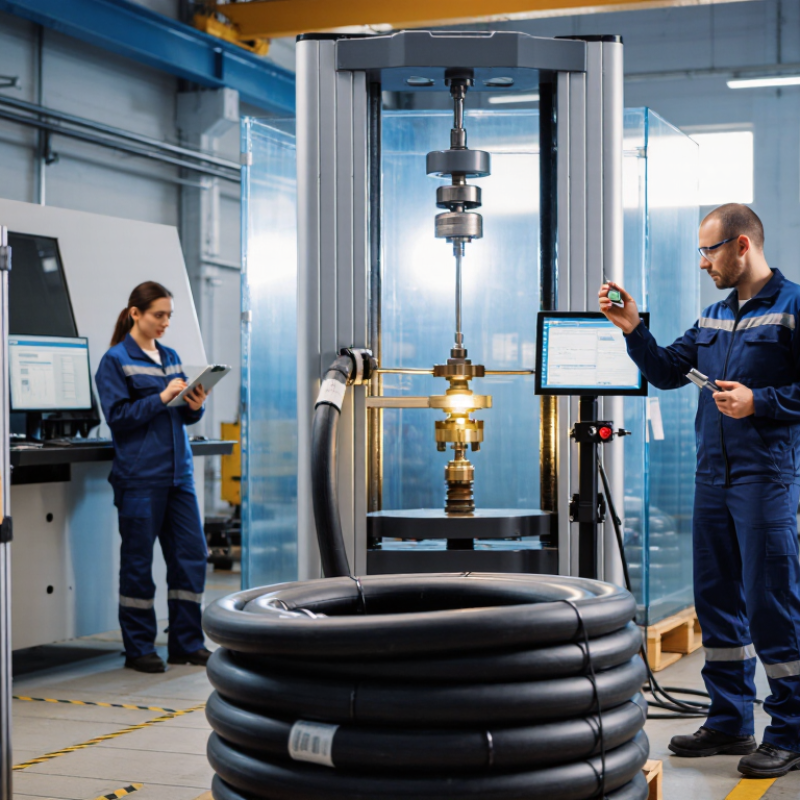
Table of Contents [Hide]
What Are Hydraulic Rubber Hoses and Why Do They Matter?
Hydraulic rubber hoses carry pressurized fluid between pumps, valves, and actuators. They must withstand pressure, heat, vibration, and repeated movement. A hose is not merely a flexible pipe. Its inner tube must resist the hydraulic fluid, while its reinforcement controls strength and expansion.
In field inspections, I check the working pressure before examining appearance. Small surface cracks can reveal heat damage or poor storage. The correct hose also needs a suitable temperature range and bend radius.
Fit is everything. A hose bent too sharply may fail near its fittings, even when its rated pressure looks sufficient.
Compatibility matters too, because different fluids can weaken rubber compounds over time.
Reliable manufacturers normally control rubber formulation, reinforcement layers, crimp dimensions, and pressure testing. They should provide clear technical data and traceable quality records. Independent testing can strengthen confidence, but paperwork cannot replace practical inspection.
I have seen hoses pass a factory check yet perform poorly after incorrect installation. That detail matters. Clean fittings, correct routing, and proper clamping reduce avoidable stress.
Some buyers focus too heavily on price, which may hide shorter service life or inconsistent dimensions. I also think specifications are sometimes treated as permanent facts; real equipment conditions change with heat, shock loads, and maintenance habits. A careful supplier should ask about the machine before suggesting a hose.