
-
- Products
- Indoor Household Cords
- Appliance Cords
- General Purpose Short-Length Cords
- General Purpose Extension Cords
- Landscape & Decorating Cords
- Bright Color Extension Cords
- Oil-Resistant Extension Cords
- Cold-Flex Extension Cords
- VividFlex Power Cords
- EXTREME All-Weather Cords
- Cord Management
- Task Lights
- Adapters & GFCI Devices
- Where to Buy
- About
- Careers
- Glossary
- Catalog


Who Are the Top LED Garden Light Manufacturers in China?
Choosing a Chinese Led Garden Light manufacturer is not simply a matter of comparing prices. A low quote may hide differences in optics, materials, testing, and support. In a garden, those details become visible after rain, during long summer evenings, and through changing seasons. One fixture may cast a clean path of light; another may leave dark patches beside the same hedge.
This overview compares manufacturers through practical factors: product range, housing and lens choices, lighting performance, customization, quality control, and export experience. Plant-lighting researcher Dr. Bruce Bugbee’s guidance can be paraphrased this way: “Measure light where plants grow, not only at the fixture.” That principle also encourages buyers to ask for photometric data instead of relying on wattage alone. Still, no single specification tells the whole story. It is easy to overlook installation conditions.
The manufacturers discussed here serve different needs, from residential paths to larger landscape projects. Their strengths should be judged against a buyer’s application, budget, and service expectations—not treated as a universal ranking. Useful questions include how a supplier tests outdoor products, whether sample units are available, and how clearly it documents materials and performance. A polished catalog is helpful, but it is not proof of long-term reliability. This comparison offers a starting point, not a substitute for checking samples, specifications, and references.
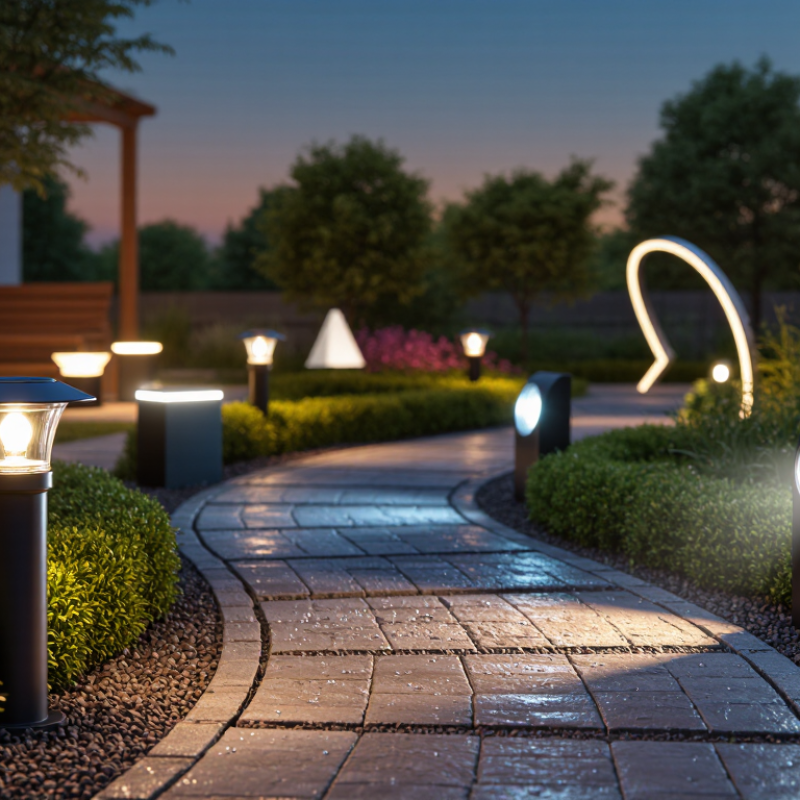
Table of Contents [Hide]
What Are LED Garden Lights and How Are They Used?
LED garden lights are outdoor luminaires that use light-emitting diodes to illuminate paths, planting beds, patios, and entrances. Common forms include low bollards beside walkways, spotlights aimed at trees, and wall-mounted fixtures near doors. They can run from mains power, low-voltage transformers, or integrated solar panels. Choose beam direction and brightness for the task: a narrow beam can highlight a trunk, while softer, shielded light helps keep a seating area comfortable. Small details matter. Wet soil, exposed cable connections, and changing plant growth can affect performance, so placement and suitable outdoor-rated equipment deserve attention.
Their value is not only decorative. The U.S. Department of Energy’s Energy Saver guidance reports that LEDs use at least 75% less energy and can last up to 25 times longer than incandescent lighting. These comparisons describe light sources, not every complete garden fixture or real-world installation. That distinction is easy to miss. For practical use, consider operating hours, maintenance access, glare, and whether solar panels receive enough direct sun. A bright fixture may still be poorly chosen if it shines into a neighbor’s window or washes out the garden’s natural texture. Lighting should help people move safely and notice specific features, not turn every corner into daylight.