
-
- Products
- Indoor Household Cords
- Appliance Cords
- General Purpose Short-Length Cords
- General Purpose Extension Cords
- Landscape & Decorating Cords
- Bright Color Extension Cords
- Oil-Resistant Extension Cords
- Cold-Flex Extension Cords
- VividFlex Power Cords
- EXTREME All-Weather Cords
- Cord Management
- Task Lights
- Adapters & GFCI Devices
- Where to Buy
- About
- Careers
- Glossary
- Catalog


Top Meat Processing Equipment Manufacturers for Global Buyers
Meat processors face a practical challenge: producing more while keeping lines dependable, cleanable, and efficient. The OECD-FAO Agricultural Outlook 2024–2033 projects global meat consumption will increase by about 12% over the decade. That forecast points to continuing investment in processing capacity, but growth alone does not determine which machinery is right for a plant.
Meat Processing Equipment spans slaughter and cutting systems, grinders, mixers, portioners, packaging lines, and cleaning solutions. The details matter. A cutter’s output rate means little if product temperatures drift or operators lose time clearing jams. Buyers should compare verified throughput, changeover time, sanitation access, spare-parts availability, and local service support. Ask manufacturers for references from facilities handling similar products and production volumes. Then check whether the quoted performance holds under real operating conditions.
This guide examines manufacturers serving global buyers, with attention to equipment range, engineering capability, and support after installation. It also considers the less visible costs: commissioning, training, maintenance, and production downtime. A specification sheet cannot reveal every awkward handoff or cleaning delay. It is easy to overlook those details. Manufacturer claims deserve careful checking, and no single supplier is automatically the best fit for every plant. The right choice depends on the product, line layout, workforce, and investment priorities.
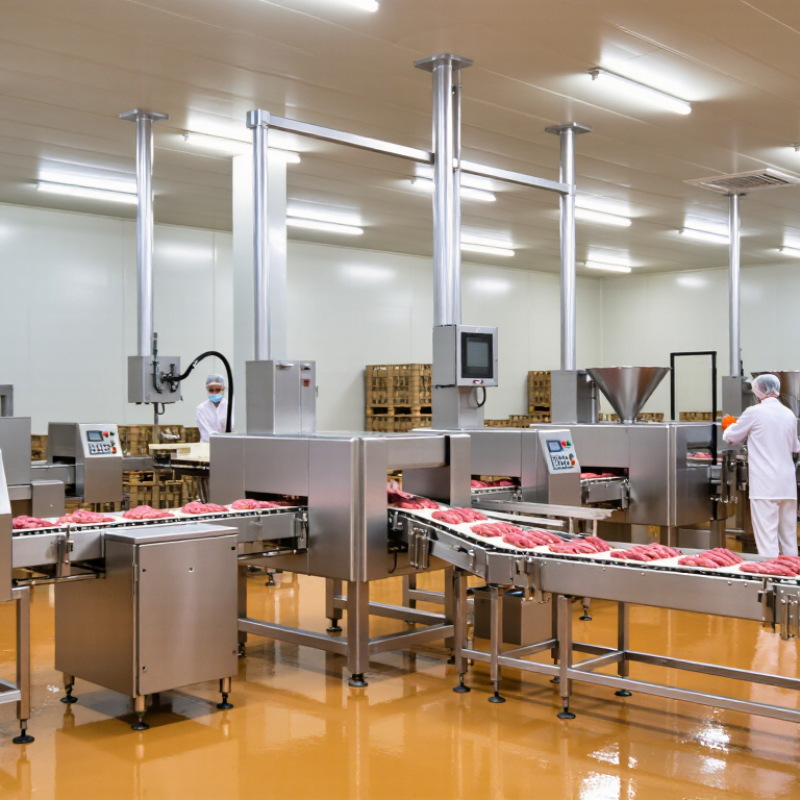
Table of Contents [Hide]
How Meat Processing Equipment Manufacturers Are Classified
Meat processing equipment manufacturers are best classified by the work their machines perform. Some specialize in primary processing, such as cutting, sawing, and deboning. Others focus on further processing, including mixing, grinding, forming, cooking, or packaging. These categories help buyers compare relevant experience instead of relying on broad product lists. A manufacturer’s stated specialty still needs checking against the actual production line.
A second useful classification is project scope. Component suppliers provide individual machines, while integrated-line manufacturers coordinate several stages, controls, and material flows. Manufacturers also differ by production scale and automation level. A compact grinder for a small facility has different throughput and service needs from a continuous, high-volume line. The categories can overlap. That makes comparison less tidy than brochures suggest.
Tips: Match equipment to your product, target output, available floor space, and cleaning routine. Ask for throughput data under conditions similar to your own, not just maximum ratings. Review spare-part access, operator training, and maintenance requirements. Small details matter. Request drawings and confirm how machines connect to existing conveyors or packaging equipment. If a supplier cannot explain operating limits clearly, pause and ask for specifics.
Top Meat Processing Equipment Manufacturers for Global Buyers – How Meat Processing Equipment Manufacturers Are Classified
| Classification | Equipment Type | Main Function | Typical Processing Stage | Key Buyer Considerations | Hygiene and Safety Points |
|---|---|---|---|---|---|
| Primary processing | Carcass splitting saw | Splits animal carcasses along the backbone into sides or halves. | Carcass dressing and primary breakdown | Consider carcass dimensions, line layout, cutting accuracy, operator ergonomics, and cleaning requirements. | Designed for frequent cleaning; safe operation requires appropriate guarding and procedures for sharp moving blades. |
| Deboning and trimming | Band saw | Cuts meat and bone into portions or specified sizes. | Portioning and bone-in cutting | Assess cutting capacity, product dimensions, blade options, ease of adjustment, and maintenance access. | Blade guards, emergency stops, and safe cleaning procedures are important considerations. |
| Size reduction | Meat grinder | Reduces meat through a cutting plate to produce minced or ground meat. | Grinding and formulation | Match the grinding system to the required particle size, product temperature, batch size, and production rate. | Product-contact parts should be accessible for thorough cleaning and sanitation. |
| Emulsifying and fine comminution | Meat emulsifier or bowl cutter | Finely chops and mixes meat ingredients; some configurations are used to produce finely comminuted mixtures. | Preparation of emulsified or finely chopped products | Review bowl or chamber capacity, cutting configuration, temperature management, and batch consistency. | Equipment should support effective cleaning of blades, bowls, and other product-contact surfaces. |
| Mixing and blending | Meat mixer | Combines meat with ingredients such as salt, seasonings, or other formulation components. | Batch preparation | Consider batch volume, mixing action, loading method, discharge design, and compatibility with downstream equipment. | Accessible product-contact areas help reduce residue buildup between batches. |
| Forming and portioning | Patty former or portioning machine | Shapes or portions ground and formulated meat into products of a defined size or weight. | Product forming | Evaluate portion consistency, changeover needs, product range, line speed, and integration with conveyors. | Product-contact components should be removable or otherwise accessible for cleaning according to the equipment design. |
| Filling and linking | Sausage stuffer or filler | Feeds prepared sausage mixture into casings or other forming equipment. | Sausage production | Compare filling control, casing compatibility, product consistency, loading method, and options for linking or portioning. | Hoppers, filling tubes, and other product-contact components require routine cleaning and sanitation. |
| Thermal processing | Smokehouse or cooking chamber | Applies controlled heat and, where configured, smoke to meat products. | Cooking, smoking, or related thermal treatment | Review chamber capacity, airflow, temperature and humidity controls, recipe management, and facility utility requirements. | Validated process controls and appropriate cleaning procedures support safe, consistent production. |
| Cooling and freezing | Chiller or industrial freezer | Removes heat from meat products to support chilled or frozen storage and handling. | Post-processing cooling and cold storage | Assess product load, target operating conditions, room or line configuration, energy use, and monitoring needs. | Temperature monitoring and effective cleaning of product areas help support hygienic operation. |
| Packaging | Vacuum packaging machine | Removes air from a package before sealing to create a vacuum package. | Final packaging | Check package format, sealing area, required throughput, changeover time, and compatibility with the intended packaging material. | Packaging surfaces and handling areas should be kept clean; packaging does not replace required temperature control. |
| Packaging | Thermoforming packaging machine | Forms packages from a flexible bottom web, fills them, and seals them with a top web. | Automated packaging | Consider package size, film specifications, tooling changes, line integration, and the level of automation required. | Product handling and cleaning arrangements should suit the intended food-processing environment. |
| Inspection and quality control | Metal detector or X-ray inspection system | Checks packaged or unpackaged products for specified foreign-material hazards, depending on system design. | In-line inspection | Choose a system based on product characteristics, package type, inspection point, line speed, and verification procedures. | Inspection equipment should be incorporated into documented quality and verification procedures. |