
-
- Products
- Indoor Household Cords
- Appliance Cords
- General Purpose Short-Length Cords
- General Purpose Extension Cords
- Landscape & Decorating Cords
- Bright Color Extension Cords
- Oil-Resistant Extension Cords
- Cold-Flex Extension Cords
- VividFlex Power Cords
- EXTREME All-Weather Cords
- Cord Management
- Task Lights
- Adapters & GFCI Devices
- Where to Buy
- About
- Careers
- Glossary
- Catalog


Top 10 Surface Mounted Components for Global Buyers
Global electronics buyers increasingly depend on Surface Mounted components for compact, reliable, and scalable product designs. These parts sit directly on the PCB surface, allowing shorter electrical paths and efficient automated assembly. A modern smartphone may contain thousands of tiny resistors, capacitors, diodes, and integrated circuits. Size matters, but it is not the whole story.
Happy Holden, a respected PCB and SMT authority, offers a useful manufacturing principle: “The best design is the one that can be built consistently.” That idea guides this overview of the Top 10 Surface Mounted Components for Global Buyers. Each component deserves practical evaluation, including package size, electrical tolerance, temperature range, moisture sensitivity, lifecycle status, and supply continuity. A low unit price can become expensive when reels arrive late or specifications change without clear notice.
The selection covers common passive parts, semiconductors, connectors, sensors, LEDs, and functional modules. It also considers procurement realities across regions, such as traceability, approved substitutions, packaging quality, and documented compliance with applicable environmental requirements. Buyers should verify current datasheets and supplier records before placing volume orders.
Some decisions remain imperfect. Smaller packages save board space, yet they can increase inspection difficulty and repair costs. Higher ratings may improve resilience, but they can also increase price and lead time. The “best” component depends on the product, factory, climate, and expected service life. Careful comparison still beats confident guessing.
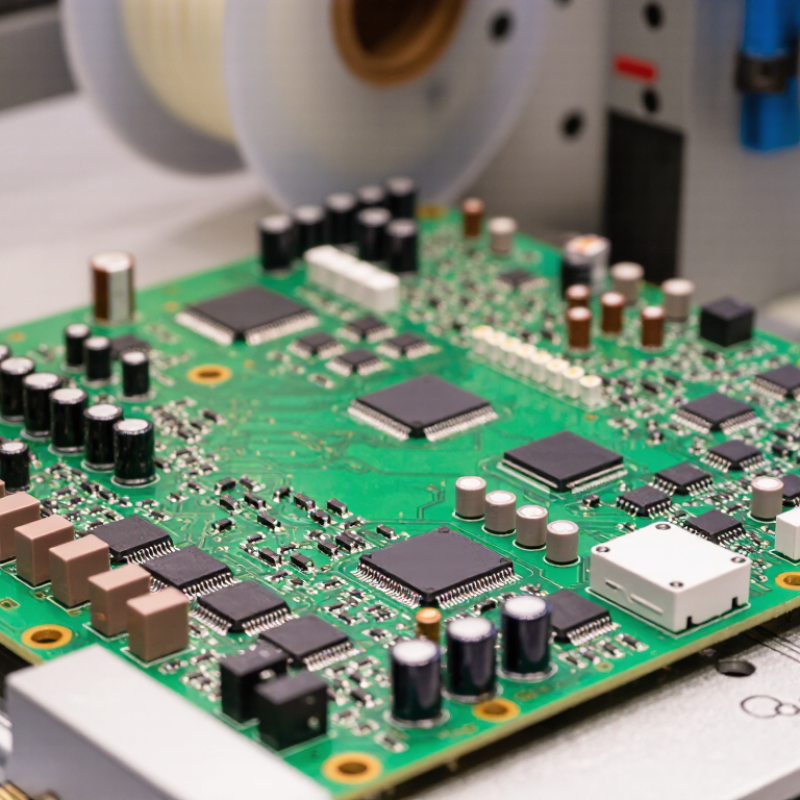
Table of Contents [Hide]
What Are Surface-Mounted Components and Why Do They Matter?
Surface-mounted components are electronic parts soldered directly onto a printed circuit board. They use short terminals or metal pads, instead of long leads passing through drilled holes. Common types include resistors, capacitors, inductors, diodes, transistors, integrated circuits, LEDs, fuses, sensors, and compact connectors. Their small footprints help designers fit more functions into smaller enclosures. This matters in industrial controls, medical instruments, transport systems, and consumer electronics. Smaller is not automatically better.
During assembly, machines place these components accurately before reflow soldering melts the paste. This supports consistent production and shorter assembly cycles. However, performance depends on package size, tolerance, voltage rating, temperature range, moisture sensitivity, and verified sourcing. A tiny capacitor can fail when its voltage margin is ignored. A power transistor may need thermal relief, not just a matching part number. I have seen purchasing teams focus on unit price and overlook inspection records. That saving can create expensive rework.
Tips: Ask for datasheets, traceability records, package drawings, and current inspection standards. Confirm polarity marks and reel specifications before ordering. Compare alternatives carefully. “Equivalent” does not always mean interchangeable. Keep a small sample lot for solderability and electrical testing. Check storage conditions, especially for moisture-sensitive packages. No checklist catches everything. Still, documented checks reduce surprises for global buyers.
Top 10 Surface Mounted Components for Global Buyers - What Are Surface-Mounted Components and Why Do They Matter?
Surface-mounted components are electronic parts designed to be soldered directly onto the surface of a printed circuit board (PCB), enabling compact layouts, automated assembly, and high production efficiency.
| Rank | Component Type | Primary Function | Common SMD Packages or Sizes | Typical Electrical Characteristics | Common Applications | Key Buying and Engineering Considerations |
|---|---|---|---|---|---|---|
| 1 | Chip Resistors | Limit current, divide voltage, set bias points, and provide termination or pull-up/pull-down functions. | 0201 0402 0603 0805 1206 | Resistance is specified in ohms; common tolerance classes include 1% and 5%. Power ratings commonly range from approximately 0.031 W to 0.25 W for standard small chip sizes. | Power supplies, control boards, sensors, consumer electronics, telecommunications, and industrial equipment. | Check resistance value, tolerance, power rating, temperature coefficient, operating temperature, pulse capability, and the PCB land pattern. |
| 2 | Ceramic Chip Capacitors | Store electrical charge, filter noise, decouple power rails, and support timing or signal-coupling circuits. | 0201 0402 0603 0805 1206 MLCC | Capacitance is specified in farads; common values range from picofarads to tens or hundreds of microfarads. Voltage ratings commonly range from a few volts to several hundred volts. | Power decoupling, RF circuits, filtering, automotive electronics, computing equipment, and embedded devices. | Evaluate capacitance under DC bias, rated voltage, dielectric type, tolerance, aging, equivalent series resistance, ripple current, and mechanical cracking risk. |
| 3 | Inductors and Ferrite Beads | Store magnetic energy, suppress high-frequency interference, filter power or signals, and support switching converters. | 0402 0603 0805 1210 Molded power | Inductance is specified in henries; current ratings depend on saturation and temperature rise. Ferrite beads are often specified by impedance at a stated frequency. | DC-DC converters, EMI filtering, automotive power systems, audio equipment, and communication circuits. | Confirm inductance, saturation current, rated current, DC resistance, impedance-versus-frequency behavior, temperature rise, and shielding requirements. |
| 4 | Rectifier and Switching Diodes | Allow current to flow mainly in one direction, provide rectification, switching, clamping, or reverse-polarity protection. | SOD-123 SOD-323 SOD-523 SMB SMC | Key parameters include repetitive peak reverse voltage, average forward current, forward voltage, reverse recovery time, and leakage current. | AC-to-DC conversion, battery protection, motor control, power adapters, signal switching, and industrial controls. | Match voltage and current ratings with adequate derating; also review thermal resistance, surge capability, switching speed, and package power dissipation. |
| 5 | Light-Emitting Diodes | Convert electrical energy into visible, infrared, or ultraviolet light for indication, illumination, sensing, or communication. | 0603 0805 1206 PLCC Power LED | Important ratings include forward voltage, forward current, luminous intensity or radiant power, dominant wavelength, viewing angle, and thermal limits. | Status indicators, displays, optical sensors, backlighting, automotive lighting, and machine interfaces. | Specify color or wavelength, brightness, current, viewing angle, binning requirements, thermal path, moisture sensitivity, and optical consistency. |
| 6 | Transistors | Act as electronic switches, amplifiers, current regulators, or signal-control devices. | SOT-23 SOT-223 DFN Power SO | Devices may be bipolar junction transistors or MOSFETs. Key ratings include breakdown voltage, continuous current, gain or on-resistance, switching speed, and power dissipation. | Load switching, motor drives, voltage regulation, amplifiers, battery systems, and power management. | Review voltage and current margins, gate-drive requirements, RDS(on) or gain, switching losses, thermal resistance, avalanche rating, and safe operating area. |
| 7 | Integrated Circuits | Combine analog, digital, power, sensing, timing, memory, or processing functions in a single semiconductor package. | SOIC TSSOP QFN QFP BGA | Specifications vary by function and may include supply voltage, operating frequency, input/output count, accuracy, current consumption, and thermal performance. | Computers, communications, industrial automation, medical instruments, automotive systems, and consumer products. | Verify package pinout, land pattern, electrical revision, lifecycle status, moisture sensitivity level, thermal design, programming needs, and traceability documentation. |
| 8 | Voltage Regulators and Power Modules | Convert an input voltage into a stable output voltage or controlled power rail. | SOT-23 SOT-223 DFN Power QFN Power module | Important parameters include input and output voltage range, output current, efficiency, dropout voltage, switching frequency, ripple, and protection features. | Embedded systems, battery-powered equipment, telecommunications, industrial controllers, and automotive electronics. | Check efficiency across the load range, thermal dissipation, transient response, required external components, electromagnetic interference, and short-circuit protection. |
| 9 | Protection Components | Protect circuits against electrostatic discharge, voltage surges, transient overvoltage, or excessive current. | TVS diode ESD array Chip fuse Resettable fuse | Specifications may include standoff voltage, clamping voltage, peak pulse current, leakage current, fuse holding current, and interrupt rating. | USB and data interfaces, battery packs, automotive electronics, industrial control panels, and power-entry circuits. | Match the protection device to the normal operating voltage, transient waveform, signal speed, fault current, response time, thermal behavior, and replacement requirements. |
| 10 | Crystals, Oscillators, and Resonators | Provide a stable reference frequency for clocks, timing, communication, and control functions. | Ceramic resonator SMD crystal Oscillator module TCXO | Key characteristics include nominal frequency, frequency tolerance, frequency stability, load capacitance, drive level, aging, start-up time, and supply voltage. | Microcontrollers, wireless equipment, networking devices, measurement systems, clocks, and industrial automation. | Confirm frequency accuracy over temperature, load capacitance, ESR, oscillator output format, start-up performance, vibration resistance, and compliance with the circuit design. |
Buyer’s note: Package names and dimensions are industry-standard examples rather than brand-specific specifications. Final selection should be based on the approved electrical rating, mechanical footprint, assembly process, environmental conditions, compliance requirements, and the latest manufacturer datasheet.