
-
- Products
- Indoor Household Cords
- Appliance Cords
- General Purpose Short-Length Cords
- General Purpose Extension Cords
- Landscape & Decorating Cords
- Bright Color Extension Cords
- Oil-Resistant Extension Cords
- Cold-Flex Extension Cords
- VividFlex Power Cords
- EXTREME All-Weather Cords
- Cord Management
- Task Lights
- Adapters & GFCI Devices
- Where to Buy
- About
- Careers
- Glossary
- Catalog


What Are the Top Types of Passive DAC Cables?
Passive Dac Cables are short-reach copper links for connecting switches, servers, and storage inside data centers. A Passive Dac Cable contains twinaxial copper conductors and uses host equipment to drive the signal, rather than built-in active electronics. That design can mean lower power use and less heat. It also limits practical reach. The cable is not a universal plug-and-play part.
The Ethernet Alliance’s 2024 Ethernet Roadmap tracks industry development across speeds including 400GbE and 800GbE. This matters because cable choice depends on both port speed and the equipment’s supported form factor. Common options include SFP+ DACs for 10GbE links, SFP28 DACs for 25GbE, QSFP28 DACs for 100GbE, and QSFP-DD or OSFP DACs for higher-capacity ports. Breakout versions connect one higher-speed port to several lower-speed ports. Check the switch manual. A matching connector alone does not guarantee compatibility.
For example, a short twinax cable may link two adjacent rack devices, while a breakout cable can connect a switch port to several servers. The Ethernet Alliance roadmap describes technology direction, not proof that every listed cable works with every device. Verify supported speeds, coding, length, and vendor compatibility before purchasing. A little caution helps. The naming can be confusing, and product listings sometimes omit details that matter. Compare the exact part numbers, then confirm the link in the equipment documentation.
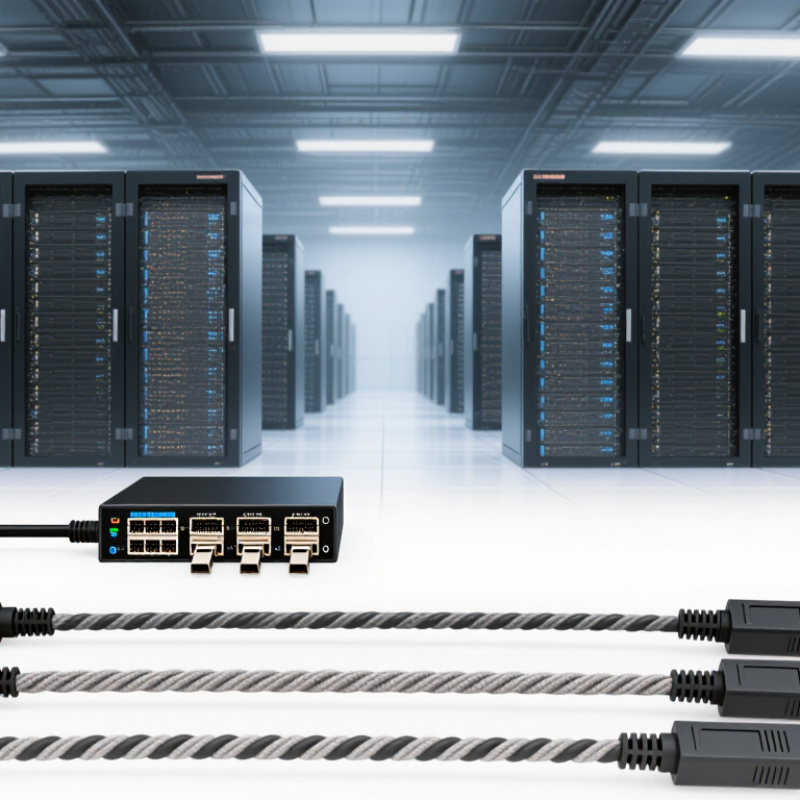
Table of Contents [Hide]
SFP+ Passive DAC: 10GBASE-CR Copper Links Reach Up to 7 m
SFP+ passive direct attach copper cables provide a short, low-power connection between compatible network ports. For 10GBASE-CR links, supported cable lengths can reach up to 7 meters. That range suits many rack connections, such as linking a switch to a nearby server. The cable contains no active signal-conditioning electronics, so it typically uses less power than an optical link. Less heat, too. Still, 7 meters is a maximum, not a guarantee for every setup. Check the cable’s stated reach and both devices’ compatibility before ordering.
Tips: Measure the actual cable route, including bends and slack. Leave room for airflow and access to neighboring ports. Confirm that each port supports the intended SFP+ passive copper connection. A cable that fits physically may not be accepted by every device.
Passive DACs are most practical when endpoints sit close together and a fixed-length cable can reach cleanly. They can simplify a rack, but they are less flexible than fiber if equipment moves or spans grow. One detail is easy to overlook: tight bends and crowded cable paths can make installation awkward. The neatest route is not always the shortest.