
-
- Products
- Indoor Household Cords
- Appliance Cords
- General Purpose Short-Length Cords
- General Purpose Extension Cords
- Landscape & Decorating Cords
- Bright Color Extension Cords
- Oil-Resistant Extension Cords
- Cold-Flex Extension Cords
- VividFlex Power Cords
- EXTREME All-Weather Cords
- Cord Management
- Task Lights
- Adapters & GFCI Devices
- Where to Buy
- About
- Careers
- Glossary
- Catalog


What Are the Top Types of Inverter Inductors?
An inverter converts direct current into alternating current, but its performance depends on more than switching devices. The Inverter Inductor stores and transfers energy, smooths current, and helps limit electrical noise. Its role changes with the inverter topology, switching frequency, power level, and control strategy. Small component, significant consequences.
Common types include boost and buck inductors, which support voltage conversion, alongside filter inductors that reduce ripple at the output. Common-mode and differential-mode inductors address different forms of conducted noise. Coupled inductors combine magnetic windings to support particular circuit functions, while planar designs can suit compact layouts and automated assembly. These categories are not always mutually exclusive; names often describe a component’s purpose, construction, or both.
Choosing among them calls for practical checks, not just a label on a datasheet. Engineers compare inductance, saturation current, winding resistance, core losses, temperature rise, and available space. For example, a tightly packed inverter may benefit from a low-profile planar part, yet thermal limits can change that choice. There is no universal “best” type. Real operating conditions matter, and the ideal selection may look less obvious after measurement. This guide introduces the main inverter inductor types, explains where each is commonly used, and outlines the trade-offs that help designers make informed comparisons.
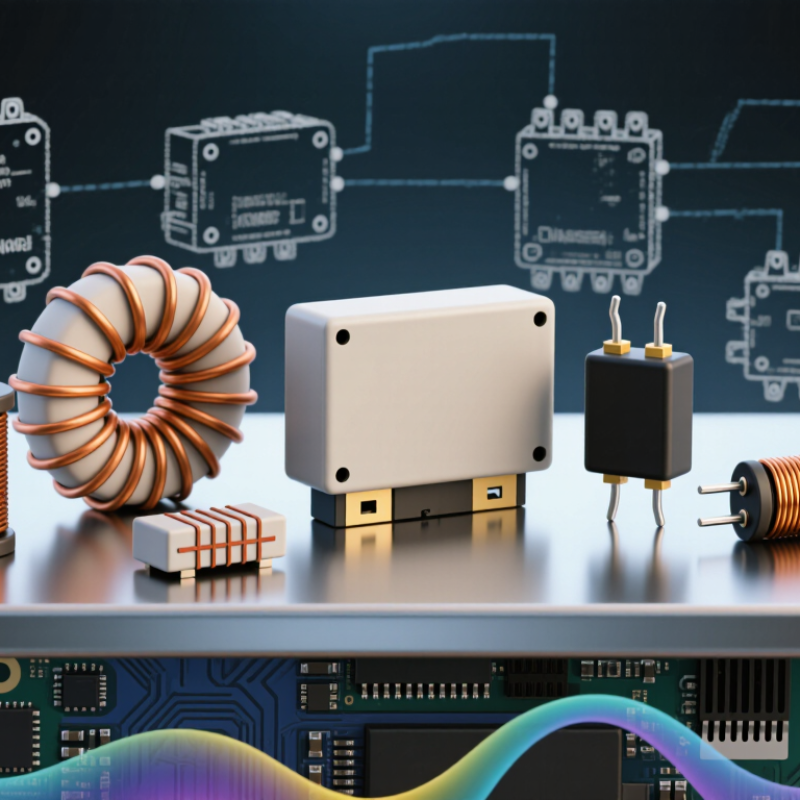
Table of Contents [Hide]
Core Designs Used in Inverter Inductors
Core Designs Used in Inverter Inductors
An inverter inductor’s core shapes its size, losses, heat, and ability to handle current. The choice depends on switching frequency, ripple current, and cooling—not just rated power. The IEA PVPS Trends in Photovoltaic Applications 2024 report estimates that solar installations added about 447 GW worldwide in 2023. That growth makes efficient power conversion increasingly important, though it does not make one core design right for every inverter.
Laminated silicon steel suits lower-frequency, high-power applications. Its thin sheets limit eddy-current losses, but the core can be bulky. Ferrite offers lower losses at higher switching frequencies and is common in compact designs; however, saturation can become a concern under heavy current. Distributed-gap powder cores, including iron-based and alloy powders, handle DC bias well and can soften saturation. Amorphous and nanocrystalline alloys can reduce core loss in suitable designs, but cost and mechanical handling may complicate production. There is no perfect core. Engineers compare measured losses across the inverter’s actual frequency and temperature range.
Tips: Check the manufacturer’s loss curves and DC-bias data at your operating conditions. Then verify temperature rise in a representative test. A small sample can mislead; winding layout and airflow matter, too.