
-
- Products
- Indoor Household Cords
- Appliance Cords
- General Purpose Short-Length Cords
- General Purpose Extension Cords
- Landscape & Decorating Cords
- Bright Color Extension Cords
- Oil-Resistant Extension Cords
- Cold-Flex Extension Cords
- VividFlex Power Cords
- EXTREME All-Weather Cords
- Cord Management
- Task Lights
- Adapters & GFCI Devices
- Where to Buy
- About
- Careers
- Glossary
- Catalog


What Is a High Mast Street Light?
A High Mast Street Light is a powerful outdoor lighting system mounted on a tall pole, often between 20 and 40 meters high. It illuminates wide areas with fewer poles. You may see these systems along highways, large intersections, ports, airports, and industrial yards.
Its purpose is more than brightness. A well-designed High Mast Street Light should provide suitable illuminance, balanced uniformity, controlled glare, and reliable visibility. Peter R. Boyce, a respected lighting researcher, states, “The purpose of lighting is to enable people to see.” This principle remains important when engineers select LED wattage, beam angles, pole spacing, and mounting height. Photometric software can model these factors before installation. Field measurements should still verify the result.
Real conditions are less tidy. Rain can reduce visibility. Dust can weaken optical performance. Strong wind can affect tall structures. Maintenance vehicles also need safe access. A design that looks efficient on paper may create dark patches or uncomfortable glare on the road. That assumption can fail.
This article explains how a High Mast Street Light works, where it fits best, and which technical details deserve attention. It will examine LED fixtures, lighting distribution, structural safety, energy use, maintenance, and project costs. Local road-lighting standards must guide the final design. No single pole height suits every site. Careful planning matters. Even experienced teams can overlook pedestrian movement, nearby homes, or reflective road surfaces. Good lighting is practical, measurable, and open to revision.
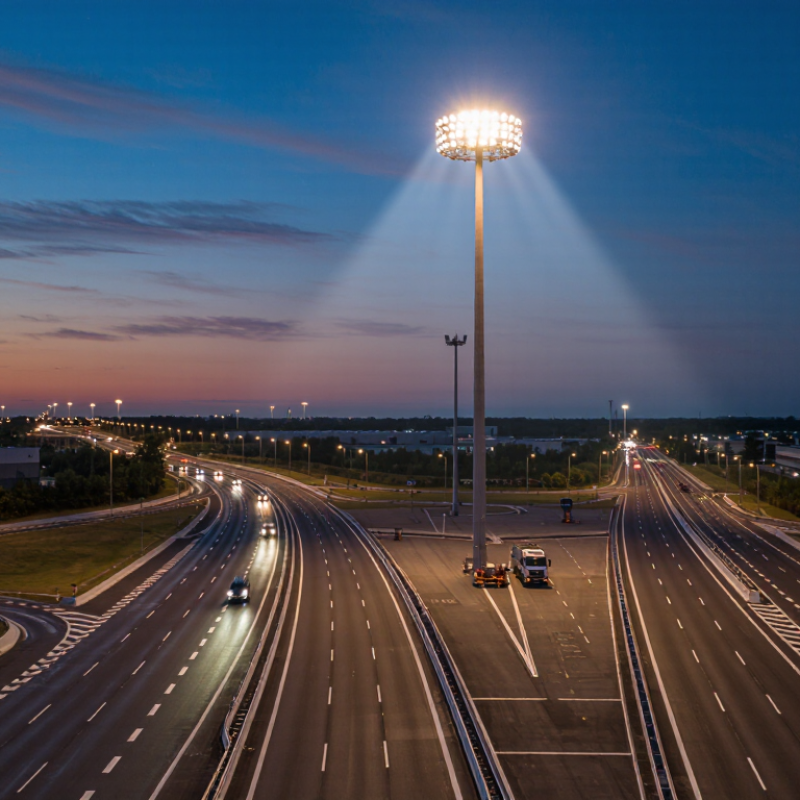
Table of Contents [Hide]
Definition and Core Features of High Mast Street Lights
What Is a High Mast Street Light?
A high mast street light is an outdoor lighting system mounted on a tall pole, usually 15 metres or higher. Its elevated position spreads light across wide areas, such as highways, ports, stadium approaches, and large junctions. The pole may support several luminaires arranged around a crown or lowering frame. This design reduces the number of poles needed, but it increases structural and maintenance demands.
Core features include high optical efficiency, wide beam distribution, corrosion-resistant materials, and reliable electrical protection. The U.S. Department of Energy’s solid-state lighting reports show that modern outdoor LED luminaires can exceed 100 lumens per watt, helping reduce energy use compared with older discharge systems. The International Energy Agency reports that lighting consumes about 15% of global electricity, so efficient road lighting remains a practical energy-saving opportunity. However, efficiency alone does not guarantee good visibility.
Engineers should check mounting height, wind loading, glare control, uniformity, and maintenance access. EN 13201 road-lighting guidance emphasizes measurable factors such as average luminance and lighting uniformity. In field inspections, dark patches often appear when beam angles are selected without accurate roadway measurements. That mistake is easy to make. Smart controls, dimming schedules, and photocells can lower operating costs, yet poor settings may create unsafe transitions or excessive darkness. Height is only one part of the design.