
-
- Products
- Indoor Household Cords
- Appliance Cords
- General Purpose Short-Length Cords
- General Purpose Extension Cords
- Landscape & Decorating Cords
- Bright Color Extension Cords
- Oil-Resistant Extension Cords
- Cold-Flex Extension Cords
- VividFlex Power Cords
- EXTREME All-Weather Cords
- Cord Management
- Task Lights
- Adapters & GFCI Devices
- Where to Buy
- About
- Careers
- Glossary
- Catalog


Why Do Boats Need Marine Batteries?
A boat depends on electricity for much more than starting its engine. Navigation lights, radios, pumps, fish finders, and emergency equipment all need dependable power. This is why Marine Batteries are designed for demanding water conditions, not simply adapted from automotive batteries.
Marine batteries face constant vibration, moisture, temperature changes, and repeated charging cycles. A starting battery delivers a powerful burst to crank an engine. A deep-cycle battery supplies steady energy for hours. Some boats use dual-purpose batteries, but that compromise is not always ideal. The right choice depends on the vessel’s size, electrical load, engine, and cruising habits.
Nigel Calder, a respected marine electrical author, has said, “A boat’s batteries are the heart of its electrical system.” His point is practical. When a battery fails offshore, the problem can become serious within minutes. A dead battery may silence a radio, stop a bilge pump, or leave an engine unable to restart.
Good installation matters too. Cable size, ventilation, terminals, charging systems, and corrosion protection all affect performance. Even the best battery can fail early when connections remain loose or saltwater reaches the terminals. That detail is easy to overlook.
There is no universal battery for every boat. Lithium batteries offer impressive weight savings, yet they require compatible charging equipment and careful monitoring. Lead-acid batteries remain heavier, but they are familiar and widely supported. The honest answer is less exciting: battery selection requires trade-offs. Understanding those trade-offs helps boat owners choose Marine Batteries that support safer, more predictable time on the water.
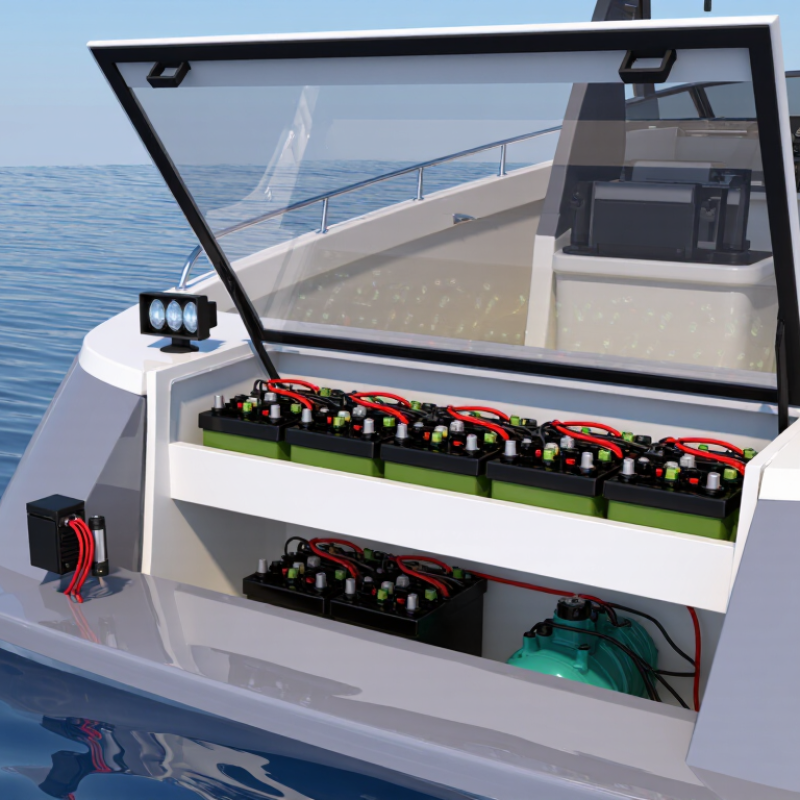
Table of Contents [Hide]
What Are Marine Batteries and How Do They Differ from Car Batteries?
Why Do Boats Need Marine Batteries?
What Are Marine Batteries and How Do They Differ from Car Batteries?
A car battery is built to deliver a brief, powerful burst to start an engine. A marine battery may also power electronics, lights, pumps, and navigation equipment while the engine is off. That difference matters. A deep-cycle marine battery is designed to provide steadier power over longer periods, while a starting battery is optimized for short bursts. Dual-purpose batteries combine both roles, though they involve a compromise.
Battery ratings help explain the distinction. The Battery Council International’s technical guidance describes reserve capacity as the number of minutes a battery can supply 25 amps at 80°F before voltage falls below its specified limit. Marine batteries commonly display this rating alongside marine cranking amps, tested at 32°F; car batteries often emphasize cold-cranking amps, tested at 0°F. These figures describe different conditions, so comparing the numbers alone can mislead. A damp locker, repeated vibration, and overnight electronics draw all affect real-world performance.
Tips: Match the battery to the boat’s engine and equipment load. Check the manufacturer’s recommended chemistry and charging profile before replacing it. Keep terminals clean, secure the battery against movement, and avoid routinely draining a starting battery to run onboard accessories. Even a “deep-cycle” label does not make every battery suitable for every boat.