
-
- Products
- Indoor Household Cords
- Appliance Cords
- General Purpose Short-Length Cords
- General Purpose Extension Cords
- Landscape & Decorating Cords
- Bright Color Extension Cords
- Oil-Resistant Extension Cords
- Cold-Flex Extension Cords
- VividFlex Power Cords
- EXTREME All-Weather Cords
- Cord Management
- Task Lights
- Adapters & GFCI Devices
- Where to Buy
- About
- Careers
- Glossary
- Catalog


Why Does a Fuel Pump Motor Commutator Wear Out?
A fuel pump can run for thousands of hours, yet its small electric motor still depends on constant contact between brushes and a rotating commutator. The Fuel Pump Motor Commutator carries current through copper segments as the armature turns. Each contact creates friction, and tiny electrical arcs can gradually mark the surface. Wear is expected. Rapid or uneven wear is not.
Several conditions can speed that process. Worn brushes, weak brush springs, poor alignment, and rough commutator surfaces can disrupt electrical contact. Heat can also damage brushes and insulation. In some pump designs, low fuel flow may reduce cooling, but the effect depends on the unit. Contamination and restricted filters may add strain to a system, though they do not prove the commutator itself has failed. That distinction matters.
Symptoms such as a noisy pump, intermittent starting, or low fuel pressure can point to several different faults. They are clues, not a diagnosis. A worn commutator may show grooves, darkened segments, or uneven brush contact when inspected by a qualified technician. Not always. The pump’s design and service history matter, too. This article explains how normal contact becomes damaging wear, which operating conditions can accelerate it, and what evidence helps separate commutator failure from other pump problems. The diagnosis is rarely tidy; one symptom alone seldom tells the whole story.
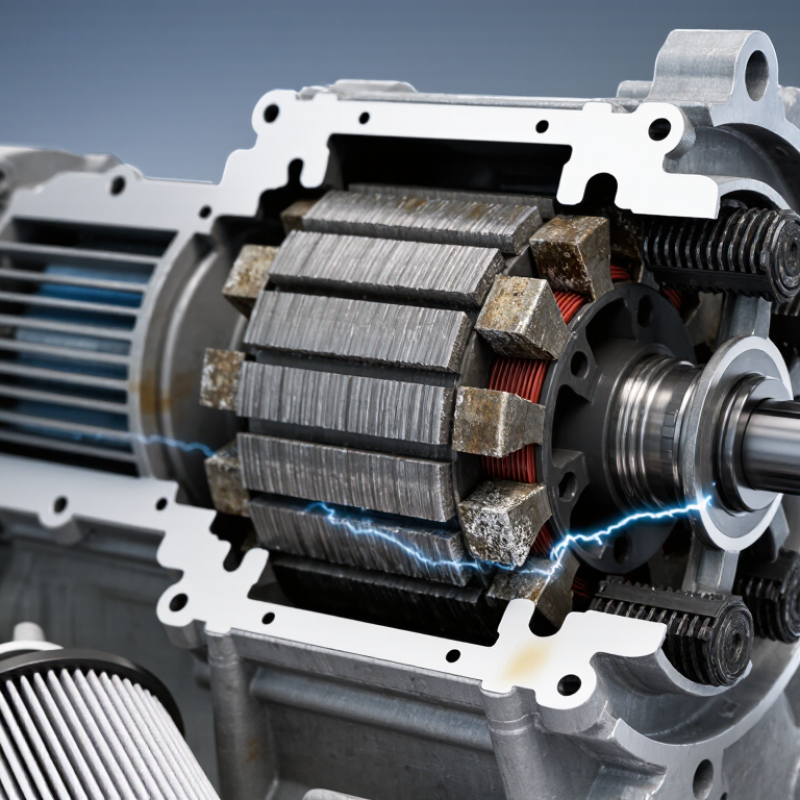
Table of Contents [Hide]
Fuel Pump Motor Commutator: Function and Construction
Fuel Pump Motor Commutator: Function and Construction
Inside many electric fuel pumps, a small DC motor turns the pumping element. Its commutator is a segmented copper cylinder attached to the motor’s rotating armature. Carbon brushes press against the segments as the armature spins. Each segment connects to a winding, and the brushes transfer current between the stationary circuit and the moving rotor. This switching reverses current through the windings at the right point in each rotation, helping the motor continue turning. That contact matters.
The commutator’s copper segments are separated by thin insulating gaps, commonly made with mica or another suitable insulation. Brush pressure must be enough for steady electrical contact, but not so high that friction rises unnecessarily. During operation, brushes gradually wear and leave fine dust; heat, contamination, poor contact, or electrical arcing can accelerate damage to the commutator surface.
The details vary by motor design, so appearance alone cannot confirm a fault. A darkened or uneven surface deserves attention, but it is not a diagnosis by itself. Honestly, wear can be subtle. A technician may need to check brush condition, electrical continuity, and rotor movement before deciding whether the motor is failing.