
-
- Products
- Indoor Household Cords
- Appliance Cords
- General Purpose Short-Length Cords
- General Purpose Extension Cords
- Landscape & Decorating Cords
- Bright Color Extension Cords
- Oil-Resistant Extension Cords
- Cold-Flex Extension Cords
- VividFlex Power Cords
- EXTREME All-Weather Cords
- Cord Management
- Task Lights
- Adapters & GFCI Devices
- Where to Buy
- About
- Careers
- Glossary
- Catalog


Why Choose NBR Seal Kits for Global Buyers?
Global buyers increasingly evaluate sealing components through lifecycle cost, material reliability, and supply continuity. A Nbr Seal Kit addresses these priorities by combining nitrile rubber seals with compatible backup rings, O-rings, and installation components. NBR is widely selected for hydraulic oil, mineral oil, and pneumatic applications because it offers balanced resistance, flexibility, and abrasion performance. It is not a universal solution.
Industry data supports this demand. Grand View Research identifies automotive, industrial machinery, and oil and gas as major application sectors for nitrile butadiene rubber. MarketsandMarkets also highlights transportation and industrial manufacturing as important growth areas for engineered rubber products. However, published market estimates vary because analysts define “NBR” differently. That difference deserves attention.
For international purchasers, the practical question is not simply whether NBR is popular. It is whether the kit matches the operating environment. Temperature, pressure, fluid type, hardness, shaft condition, and storage time can change performance. A seal that works well in a clean hydraulic cylinder may swell in aggressive fuel or fail under excessive heat. Small details matter. For example, a 70 Shore A seal may suit one assembly, while another needs a different hardness and profile.
Experienced suppliers should provide material specifications, dimensional drawings, batch traceability, and test documentation. ISO 3601 is commonly referenced for O-ring dimensions and quality requirements, while ASTM D2000 helps classify rubber performance. These standards improve communication, but they do not replace application testing. That is the uncomfortable part. A lower purchase price can become expensive after leakage, downtime, or field replacement. Choosing an Nbr Seal Kit therefore requires evidence, not attractive claims.
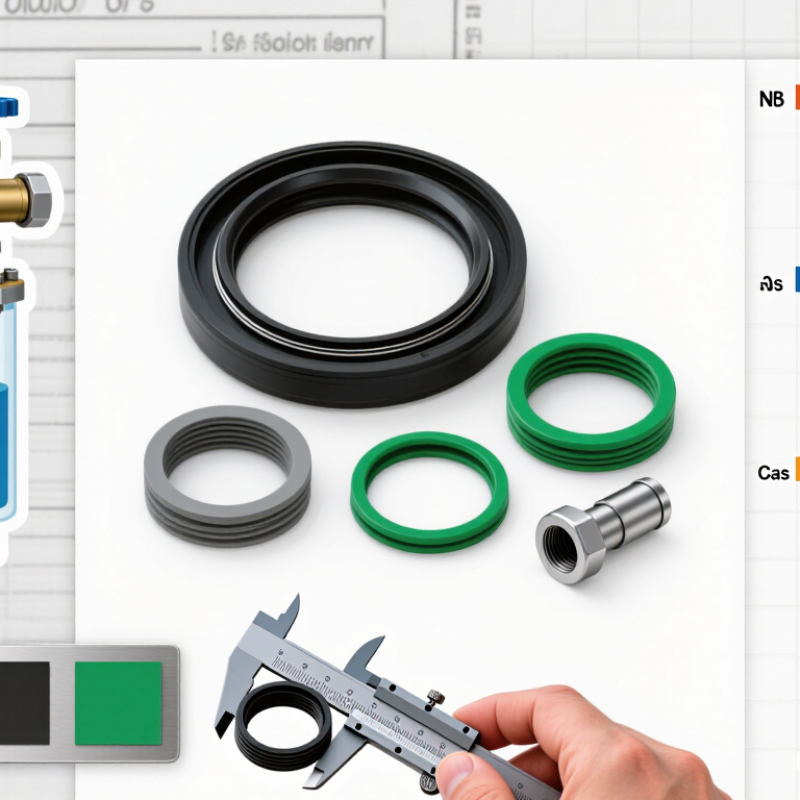
Table of Contents [Hide]
What Is an NBR Seal Kit and How Does It Work?
What Is an NBR Seal Kit and How Does It Work?
An NBR seal kit contains molded nitrile rubber rings, backup rings, wipers, and sometimes guide elements. These parts sit inside hydraulic or pneumatic equipment. When pressure rises, the NBR seal presses against the rod, piston, or housing wall. This contact blocks oil, fuel, and air from escaping. NBR performs well in petroleum-based fluids and common industrial oils. Typical service temperatures range from about -30°C to 100°C, depending on the compound and design.
According to Grand View Research’s 2024 analysis, the global industrial seals market continues to expand with demand from manufacturing, energy, and mobile machinery. A 2023 report from MarketsandMarkets also identified fluid-power equipment as a major application area for sealing products. These figures explain why global buyers often choose NBR kits for routine maintenance. They are practical, replaceable, and usually cost-efficient. Still, NBR is not universal. Strong ozone exposure, aggressive chemicals, excessive heat, or unsuitable fluids can cause swelling and early cracking. That detail is easy to miss.
Tips: Match the kit with the exact groove size, shaft diameter, pressure, and fluid. Check the material grade, not only the NBR label. Clean the housing carefully before installation. A tiny metal particle can cut a fresh seal. Store unused kits away from sunlight and ozone. Some purchasing decisions look correct on paper, yet field conditions prove otherwise.