
-
- Products
- Indoor Household Cords
- Appliance Cords
- General Purpose Short-Length Cords
- General Purpose Extension Cords
- Landscape & Decorating Cords
- Bright Color Extension Cords
- Oil-Resistant Extension Cords
- Cold-Flex Extension Cords
- VividFlex Power Cords
- EXTREME All-Weather Cords
- Cord Management
- Task Lights
- Adapters & GFCI Devices
- Where to Buy
- About
- Careers
- Glossary
- Catalog


Why Use a Safety Lockout Box for Workplace Safety?
A Safety Lockout Box is more than a container for padlocks and tags. It is a visible control point for hazardous-energy procedures. In a busy maintenance area, it can hold group lockout devices, keys, tags, hasps, and written instructions. That organization matters when several workers service one machine.
Safety consultant Jeffrey Dalto explains, “A lockout box helps make group lockout responsibilities visible and controlled.” His observation reflects a practical concern. Workers should know who applied each personal lock and whether every person has removed it before equipment returns to service. A clear box location can reduce confusion near electrical panels, conveyors, presses, and pneumatic systems.
The value depends on the system around it. A box cannot replace machine-specific procedures, competent training, or verification of zero energy. It also cannot correct weak communication between shifts. That is where many programs struggle.
A strong process begins with preparation. Identify every energy source. Shut down the equipment. Isolate the sources. Release stored pressure, tension, heat, or motion. Then verify isolation with suitable testing methods. Each authorized worker should apply a personal lock according to site procedures.
Small details reveal real performance. Are replacement tags available? Are broken locks reported immediately? Can a night-shift employee understand the box’s instructions without guessing?
No system is perfect. A Safety Lockout Box may be installed correctly yet remain unused, poorly labeled, or forgotten during urgent repairs. Regular inspections, worker feedback, and honest review can expose those gaps. Used consistently, it supports a safer, more disciplined approach to hazardous-energy control.
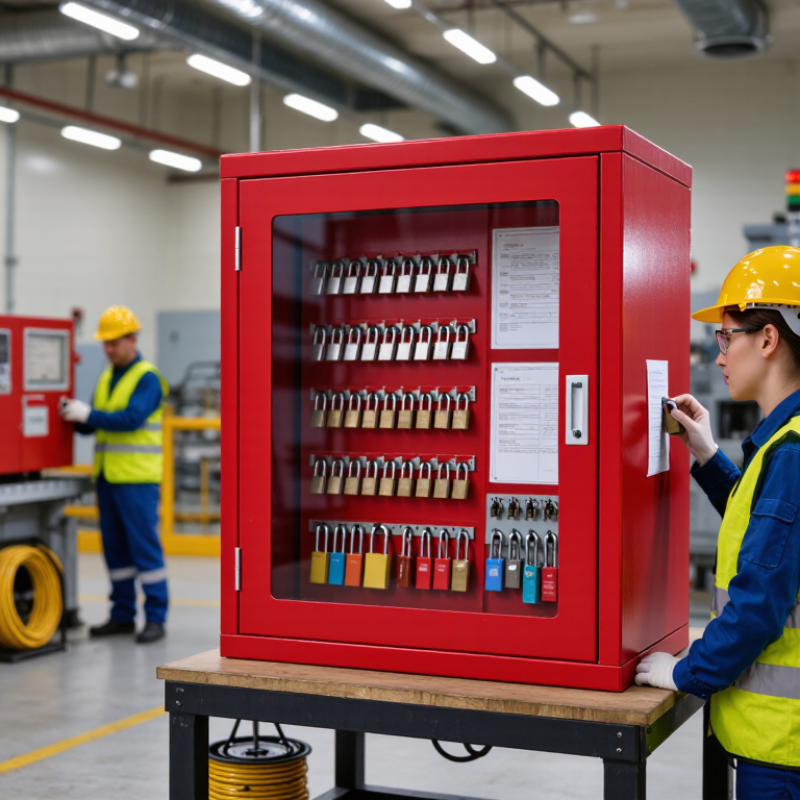
Table of Contents [Hide]
Lockout/Tagout Fundamentals: OSHA 1910.147 and 120 Preventable Deaths
Why Use a Safety Lockout Box for Workplace Safety?
Lockout/tagout controls hazardous energy during servicing and maintenance. OSHA 1910.147 requires employers to isolate electrical, mechanical, hydraulic, pneumatic, and thermal energy sources. A safety lockout box keeps keys, locks, tags, and instructions together. It also supports group lockout procedures, where each authorized worker applies a personal lock before work begins.
The often-cited estimate of 120 preventable deaths shows why this control matters. These incidents may involve unexpected machine startup, stored pressure, or a disconnected switch that was never verified. A lockout box cannot replace training or proper isolation. It creates a visible checkpoint. People get rushed. That gap matters. Before touching equipment, workers should identify every energy source, shut down the machine, isolate it, release stored energy, and verify zero energy. Verification should use the correct test method, not a quick assumption.
OSHA also expects written procedures, employee training, and periodic inspections. Supervisors should check whether workers understand the procedure, not merely whether forms are complete. A perfect procedure on paper can still fail beside a noisy machine. In my experience, forgotten secondary energy sources cause serious confusion. Batteries, elevated parts, capacitors, and trapped air deserve attention. The person performing the work should confirm isolation personally. Small details decide. A durable lockout box helps organize those details, but disciplined behavior remains essential.
Why Use a Safety Lockout Box for Workplace Safety? - Lockout/Tagout Fundamentals: OSHA 1910.147 and 120 Preventable Deaths
| Safety Dimension | Verified Requirement or Fact | How a Lockout Box Helps | Practical Control | Reference |
|---|---|---|---|---|
| Purpose of lockout/tagout | The standard protects employees from the unexpected energization, start-up, or release of stored energy during servicing and maintenance. | Keeps the controlling keys and personal locks organized and prevents unauthorized re-energization. | Use a documented energy-control procedure before work begins. | 29 CFR 1910.147(a)(1)(i) |
| Who applies locks | Authorized employees who perform servicing or maintenance must apply lockout or tagout controls. | Provides a central location for personal locks, group lock devices, and control keys. | Assign each authorized employee a uniquely identifiable personal lock. | 29 CFR 1910.147(b), (d) |
| Group maintenance work | When a group performs servicing, each authorized employee must receive equivalent protection through a group lockout or tagout procedure. | Allows multiple workers to attach personal locks while one group device controls the energy-isolating mechanism. | No employee removes their lock until their work is complete and they are clear of the hazard. | 29 CFR 1910.147(f)(3) |
| Energy sources | Hazardous energy may include electrical, mechanical, hydraulic, pneumatic, chemical, thermal, or gravitational energy. | Helps store the locks, tags, hasps, and blocking devices needed for different energy-isolation points. | Identify every energy source and release, restrain, or dissipate stored energy before work. | 29 CFR 1910.147(d)(3) |
| Verification before work | After isolation and lockout, the authorized employee must verify that isolation and de-energization have been accomplished before starting work. | Makes verification tools and required documentation easier to keep together and access. | Test the equipment using an appropriate method, then return controls to the off or neutral position. | 29 CFR 1910.147(d)(6) |
| Lock removal | Each lockout or tagout device must generally be removed by the employee who applied it, subject to a documented employer procedure for exceptional cases. | Reduces the risk of misplaced locks and provides a controlled location for identifying the responsible employee. | Confirm the employee is unavailable, make reasonable efforts to contact them, and inform them before returning to work. | 29 CFR 1910.147(e)(3) |
| Training categories | Authorized, affected, and other employees require training appropriate to their role in the energy-control process. | Supports a consistent system in which workers understand who may apply, remove, or work around locks. | Train authorized employees on energy sources, hazards, procedures, and limitations of tags. | 29 CFR 1910.147(c)(7) |
| Annual inspection | Each energy-control procedure must be inspected at least annually to verify that it is followed and remains adequate. | Provides a practical place to keep inspection records, corrective actions, and procedure-review materials. | Use an authorized employee who is not the employee using the procedure being inspected. | 29 CFR 1910.147(c)(6) |
| Tags versus locks | A tag is a warning device and does not provide the same physical restraint as a lock. Tagout-only systems require additional protective measures where permitted. | Encourages the use of physical locks and controlled group devices instead of relying solely on warning labels. | Use lockout whenever the energy-isolating device can be locked out, unless an exception under the standard applies. | 29 CFR 1910.147(c)(2) |
| Preventable fatality risk | Industry safety materials commonly cite approximately 120 fatalities and many thousands of injuries each year as preventable outcomes associated with hazardous energy. This figure is an estimate used in safety communications, not a single OSHA annual count. | Creates visible accountability and reduces the chance that a worker’s lock or group-control step is skipped. | Treat every unexpected start-up or energy release as a potentially fatal event and stop work when controls are incomplete. | OSHA: Control of Hazardous Energy |