-
- Products
- Indoor Household Cords
- Appliance Cords
- General Purpose Short-Length Cords
- General Purpose Extension Cords
- Landscape & Decorating Cords
- Bright Color Extension Cords
- Oil-Resistant Extension Cords
- Cold-Flex Extension Cords
- VividFlex Power Cords
- EXTREME All-Weather Cords
- Cord Management
- Task Lights
- Adapters & GFCI Devices
- Where to Buy
- About
- Careers
- Glossary
- Catalog


What Is the Best Short Extension Cord Made in China?
Choosing the best short extension cord made in China requires more than comparing prices or counting online reviews. The phrase “best” is incomplete. A cord for a bedside lamp differs from one used beside a workbench. Wire gauge, rated load, plug design, insulation, strain relief, and heat resistance can change the safety margin.
Safety data makes this decision practical, not cosmetic. The U.S. Consumer Product Safety Commission has reported about 3,300 residential fires linked to extension cords annually, with roughly 50 deaths and 270 injuries. These figures show why construction deserves careful attention. A thin cable under a rug may warm quietly. A loose plug may spark after repeated bending. Small details matter.
Relevant standards offer a stronger comparison framework. UL 817 covers cord sets and power-supply cords in the United States, while IEC 60884-1 addresses household plugs and socket outlets. China-made products may also carry CCC certification for applicable domestic products, but certification requirements differ by destination market. Buyers should verify the actual marking, test documentation, conductor size, and rated amperage. A familiar logo alone proves little.
This guide examines short extension cord options made in China through those measurable details. It considers everyday use, portability, durability, and supplier transparency. It also recognizes an uncomfortable point: manufacturing origin does not guarantee quality, and it does not prove poor quality either. The best choice depends on verified specifications, realistic loads, and responsible use. That judgment takes more than a quick shopping glance.
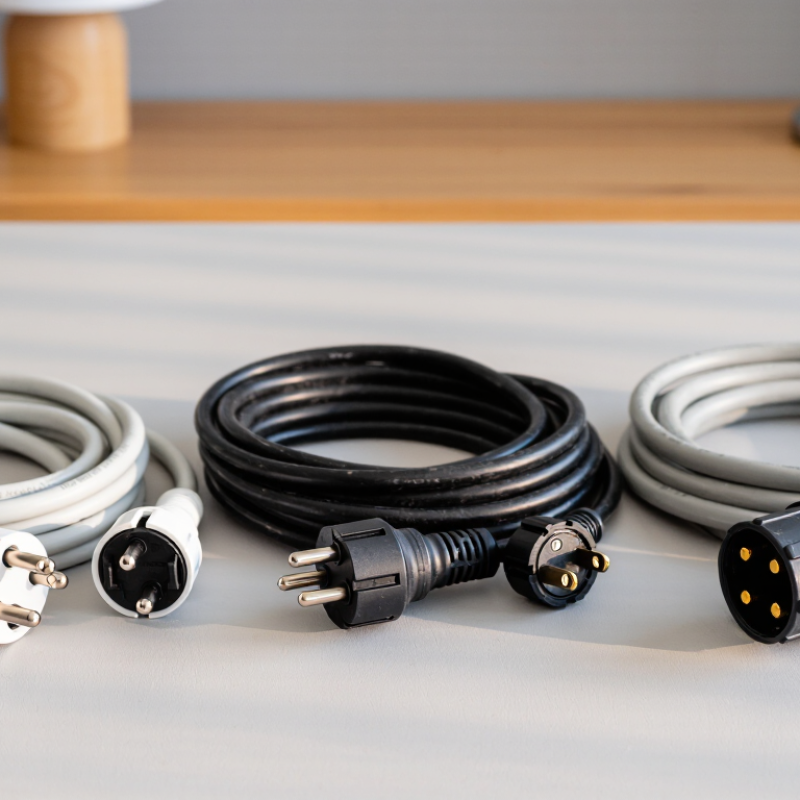
Table of Contents
[Hide]
What Defines a High-Quality Short Extension Cord?
The best short extension cord made in China is defined by engineering, not country of origin. A high-quality cord uses correctly sized copper conductors, secure insulation, and a strong strain relief. Even a 1.5-meter cord can overheat when its conductor is too small or tightly coiled. The NFPA report Home Fires Involving Extension Cords recorded about 3,300 residential fires, 50 deaths, and 270 injuries annually from 2013 to 2017. These figures make thermal control essential.
Look for clear markings showing wire size, voltage, current rating, and grounding details. The plug should fit firmly without wobbling. Its contact surfaces should maintain low electrical resistance. A flexible jacket should resist abrasion, bending, and moderate heat. Testing should reference recognized requirements, such as UL 817 or IEC 60884-1, when applicable. Factory inspection should include conductor resistance, insulation strength, polarity, grounding continuity, and repeated flex tests.
Small details matter. A molded plug helps. So does a visible production code. The U.S. Consumer Product Safety Commission also identifies overloaded and damaged extension cords as recurring fire risks in household safety data. A smooth jacket alone proves little. I would still question cords with vague labels, stiff insulation, or weak plug entry points. One practical weakness remains: laboratory results may not reflect years of bending beside a desk or heater. Traceable materials, documented testing, and honest ratings provide stronger evidence than appearance.
What Is the Best Short Extension Cord Made in China? - What Defines a High-Quality Short Extension Cord?
| Evaluation Dimension | High-Quality Benchmark | Recommended Verification | Why It Matters |
|---|---|---|---|
| Typical Short Length | Approximately 0.3–1.8 m (1–6 ft), selected according to the distance required. | Measure the cable from plug to receptacle and confirm the stated tolerance. | A shorter cord is easier to manage and generally produces less voltage drop than a longer cord of the same construction. |
| Conductor Material | Stranded, annealed copper conductors with a clearly stated wire gauge or cross-sectional area. | Review the technical specification and verify conductor resistance through production testing. | Copper provides good electrical conductivity, flexibility, and heat performance when properly sized. |
| Conductor Size | For a common North American 125 V design, 16 AWG is often used for up to 13 A applications; the actual rating must be stated by the manufacturer. | Check the printed rating, conductor gauge, temperature rise, and applicable electrical requirements for the destination market. | Adequate conductor size helps control heating and voltage drop under the rated load. |
| Rated Voltage and Current | Clear markings such as rated voltage, maximum current, and maximum power; a typical U.S. cord may be marked 125 V and 13 A when designed and tested for that rating. | Compare the rating label with the plug configuration and the destination country's electrical requirements. | Clear ratings prevent users from connecting loads that exceed the cord's safe operating limits. |
| Grounding Configuration | A three-conductor design with a grounding pin and grounding contact when intended for grounded equipment. | Perform plug-to-receptacle continuity and polarity tests; inspect that the grounding path is not interrupted. | A continuous grounding path helps reduce shock risk when used with grounded appliances and tools. |
| Jacket and Insulation | A flexible jacket type appropriate for the application, such as SJT or SJTW for many North American portable-cord applications, with a stated temperature rating. | Check the jacket marking, flexibility, abrasion resistance, and suitability for indoor or outdoor use. | The jacket protects conductors from abrasion, bending, moisture, and environmental exposure. |
| Plug and Receptacle Construction | Firmly molded or securely assembled parts, tight contacts, correctly aligned slots, and no exposed live conductive material. | Inspect contact tension, insertion fit, molding quality, terminal security, and resistance after repeated insertion cycles. | Reliable contacts reduce arcing, localized heating, intermittent power, and premature wear. |
| Strain Relief | Flexible, well-molded strain relief at both ends that prevents sharp bending where the cable enters the plug or receptacle. | Conduct bend, pull, and flex-cycle tests according to the applicable product standard. | Effective strain relief protects the internal terminals from mechanical fatigue and conductor breakage. |
| Electrical Safety Testing | Routine checks for continuity, polarity, grounding, dielectric withstand, insulation resistance, and conductor resistance. | Request production test records and independent laboratory reports applicable to the intended market. | Testing identifies insulation faults, wiring errors, weak connections, and leakage risks before shipment. |
| Thermal Performance | Temperature rise remains within the limits required by the applicable safety standard when operated at the marked load. | Use a calibrated load bank or equivalent test equipment and record temperature at the plug, receptacle, cable, and terminals. | Excessive heat can damage insulation and increase the risk of fire. |
| Voltage Drop | Low voltage drop at the declared maximum load, supported by conductor-size and resistance data. | Measure the voltage at the source and at the cord's output while applying the rated load. | Lower voltage drop improves equipment performance and reduces unnecessary heating. |
| Standards and Certification | Compliance with the electrical and safety requirements of the destination market, supported by a valid, traceable certification or test report. | Verify the certificate number, product scope, manufacturing site, ratings, and report validity with the issuing organization. | Certification provides evidence that the product has been assessed against recognized safety requirements. |
| Manufacturing Origin | Made in China with accurate country-of-origin labeling, documented quality controls, and traceable batch records. | Review factory inspection records, incoming-material controls, in-process checks, and final inspection data. | Country of manufacture alone does not determine quality; consistent engineering and quality control are more important. |
| Best Overall Selection | Choose the shortest cord that reaches the equipment, has the correct grounded configuration, matches the required voltage and current, and provides verifiable safety testing. | Compare the technical label, construction, test documentation, and intended-use suitability rather than relying only on appearance or price. | The best short extension cord is the one correctly matched to the application and supported by objective safety evidence. |
Related Posts
-
How to Choose a Short Extension Cord in 2026?
-

How to Choose the Right Extension Cord Wire for Your Needs?
-
Best 10 Short Extension Cord Options for Every Need?
-

Why You Need an Extension Cord Cable for Every Home and Office?
-
10 Essential Tips for Choosing the Right Power Cord Extension Cable for Your Needs
-
Top 10 Extension Cables: Your Ultimate Guide to Choosing the Best