How to Choose the Right Power Cord Wire for Global Sourcing?
Choosing the right power cord wire for global sourcing requires more than comparing prices. It demands careful attention to electrical performance, regional requirements, and supplier reliability. A cord used beside a factory machine may face heat, oil, repeated bending, and daily movement. A household cord may need different insulation, flexibility, and plug protection. The application comes first.
Voltage, frequency, current rating, conductor size, insulation material, and temperature resistance must match the intended market. Plug shapes also vary across countries. A cord suitable for North America may not meet the connection needs of Europe, Australia, or other regions. Relevant standards may include IEC, UL, CSA, or national requirements, depending on the destination. Requirements can change. Verify them with qualified compliance professionals before production.
Practical sourcing experience shows that documentation deserves the same attention as the cable itself. Ask suppliers for test reports, material specifications, factory quality records, and traceable batch information. Inspect markings, conductor construction, strain relief, and terminal crimping. A small labeling error can delay an entire shipment. It happens. Sample testing should include bending, pull strength, insulation resistance, and heat exposure where appropriate. Do not rely only on a supplier’s brochure. Independent verification adds confidence, especially for large orders or unfamiliar factories. However, even a strong checklist may miss real-world handling problems. Review failures honestly, improve the specification, and keep communication clear from design through delivery. A dependable power cord wire is not merely compatible; it must remain safe, identifiable, and consistent across different markets.
Define Voltage and Frequency by Market (IEC 60038: 100–240 V Systems)
Choosing a power cord begins with the destination market’s nominal voltage and frequency. IEC 60038 lists standard systems such as 230 V at 50 Hz and 120 V at 60 Hz. A product marked “100–240 V” may accept both ranges, but its cord still needs the correct plug, insulation, and current rating. The IEA Electricity 2024 report forecasts global electricity demand growth above 4% in 2024, showing why sourcing teams must expect different grid conditions.
Voltage changes current demand. A 1,000-watt appliance draws about 10 amps at 100 V, but only 4.35 amps at 230 V. That difference affects conductor size, temperature rise, and connector safety. I usually check the appliance label, rated input, frequency, and maximum current before reviewing the cord design. Small details matter.
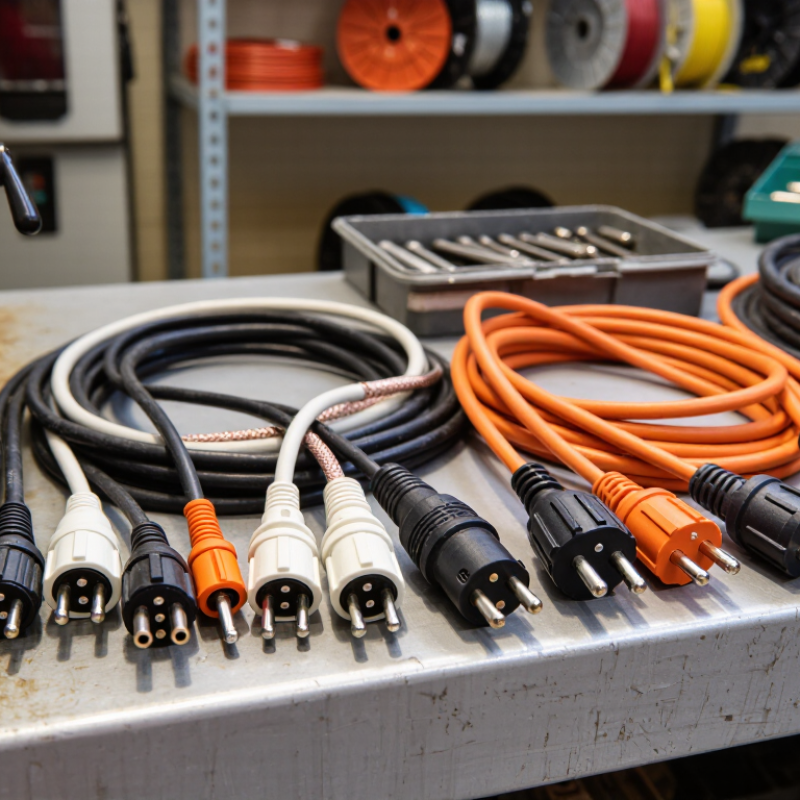
Frequency rarely changes the copper size directly, but it can affect motors, transformers, and heating controls. A cord approved for one market may still be unsuitable for another. IEC 60320 requirements, national approval schemes, and local plug dimensions should be verified together. Do not rely on voltage alone. A practical review should include a 100 V worst-case current calculation, flexing tests, and insulation checks at the expected ambient temperature. I have seen sourcing teams skip the frequency line because the product worked in a factory test. That assumption needs challenging. Production success is not market validation.
Select Conductor Size by Ampacity (IEC 60228: Classes 1, 2, 5, and 6)
Choosing the right power cord wire starts with current demand, not appearance. In global sourcing, conductor size should match ampacity under the actual operating conditions. A larger conductor usually carries more current, but installation temperature, insulation rating, bundling, and ventilation also affect performance.
IEC 60228 defines conductor construction classes. Class 1 uses solid conductors for fixed installations. Class 2 uses stranded conductors and offers better handling. Class 5 uses flexible fine strands, while Class 6 provides even greater flexibility. The class describes construction and flexibility, not ampacity by itself. The numbers matter.
For example, a portable appliance with repeated movement may need Class 5 or Class 6 conductors. A fixed cabinet connection may suit Class 1 or Class 2. After choosing the class, verify the conductor cross-sectional area against the expected load and applicable installation rules. Then check voltage drop, maximum conductor temperature, fault conditions, and terminal compatibility.
A practical sourcing review should request resistance data, conductor size, insulation temperature rating, and test documentation. Do not rely only on a supplier’s current chart. Charts may use different ambient temperatures or installation methods. I have seen apparently identical cords perform differently when bundled tightly or routed through warm equipment. That detail is easy to miss. Recheck the calculation. Real installations are rarely perfect.
How to Choose the Right Power Cord Wire for Global Sourcing? - Select Conductor Size by Ampacity (IEC 60228: Classes 1, 2, 5, and 6)
| Nominal Conductor Cross-Section |
Typical Indicative Current
for Portable Copper Cord |
Maximum DC Resistance at 20°C
for Class 5 / Class 6 Conductors |
IEC 60228 Conductor Classes |
Flexibility and Typical Use |
Global Sourcing Checkpoint |
| 0.50 mm² |
Up to 3 A |
39.0 Ω/km |
Class 5 or Class 6 |
Flexible appliance leads, signal-related power connections, and lightweight portable products. |
Confirm the applicable national cord standard and minimum rated current before selection. |
| 0.75 mm² |
Up to 6 A |
26.0 Ω/km |
Class 5 or Class 6 |
Common flexible size for low-to-medium power household and office equipment. |
Check plug, connector, fuse, temperature rating, and permitted cord length. |
| 1.00 mm² |
Up to 10 A |
19.5 Ω/km |
Class 5 or Class 6 |
Flexible supply cords for general-purpose equipment and moderate loads. |
Verify voltage drop and heating when the cord is bundled, coiled, or enclosed. |
| 1.50 mm² |
Up to 16 A |
13.3 Ω/km |
Class 1, Class 2, Class 5, or Class 6 |
Widely used for higher-current portable appliances and extension cords. |
Confirm the complete cord assembly rating; the plug and socket may limit the current. |
| 2.50 mm² |
Up to 20 A |
7.98 Ω/km |
Class 1, Class 2, Class 5, or Class 6 |
Heavy-duty flexible cords, workshop equipment, and longer extension leads. |
Evaluate voltage drop, conductor temperature, bend radius, and mechanical protection. |
| 4.00 mm² |
Up to 25 A |
4.95 Ω/km |
Class 1, Class 2, Class 5, or Class 6 |
High-load portable equipment and industrial flexible cable assemblies. |
Check termination capacity and whether the selected connector accepts the conductor size. |
| 6.00 mm² |
Up to 32 A |
3.30 Ω/km |
Class 1, Class 2, Class 5, or Class 6 |
Heavy-duty power distribution and demanding portable applications. |
Confirm installation method, ambient temperature, grouping, and overcurrent protection. |
| 10.00 mm² |
Up to 40 A |
1.91 Ω/km |
Class 1, Class 2, Class 5, or Class 6 |
Large portable equipment and industrial power connections. |
Use suitably rated terminals, glands, plugs, and strain-relief components. |
| 16.00 mm² |
Up to 63 A |
1.21 Ω/km |
Class 1, Class 2, Class 5, or Class 6 |
Very high-current flexible assemblies and industrial distribution equipment. |
Obtain a project-specific ampacity calculation and verify thermal performance. |
Technical note: IEC 60228 defines conductor construction, nominal cross-sectional area, resistance limits, and flexibility classes; it does not provide one universal ampacity value for every installation. The current figures above are simplified indicative references for copper portable cords and must be validated against the applicable installation standard, ambient temperature, number of loaded conductors, cable length, grouping, insulation temperature rating, voltage-drop limit, and local product regulations. Class 1 means solid conductors, Class 2 stranded rigid conductors, Class 5 flexible conductors, and Class 6 extra-flexible conductors.
Match Plug and Socket Ratings (IEC 60884-1: Up to 250 V and 16 A)
When sourcing a power cord globally, match the plug and socket ratings before selecting the wire. IEC 60884-1 covers relevant household plugs and socket-outlets, commonly up to 250 V and 16 A. These limits are not automatic approval for every cord design. The actual product rating must remain within the marked rating of both connector parts.
Check the voltage, current, frequency, pin configuration, and grounding arrangement. A 16 A plug does not make a thin conductor suitable for 16 A operation. Wire size, insulation temperature, conductor material, flexing, and cable length also affect safe performance. In practical inspections, I compare the cord label with the plug marking, then review the socket specification used in the destination market. Small mismatches often appear during this step.
Look closely.
For example, a cord rated for 250 V may still be unsuitable if its current rating is lower than the socket rating. Likewise, a grounded plug requires a properly connected protective conductor, not an unused green-yellow wire. Test reports, dimensional checks, material records, and production samples provide stronger evidence than a supplier’s brief statement. I have seen sourcing teams focus on the plug shape and overlook heat buildup near the strain relief. That decision needs reconsideration. A careful buyer should verify the complete cord assembly against applicable national requirements, because IEC alignment alone may not satisfy every market’s installation or safety rules.
Verify Insulation Temperature Limits (IEC 60227: PVC Rated to 70°C)
How to Choose the Right Power Cord Wire for Global Sourcing?
When sourcing a power cord, verify its insulation temperature limit before comparing price or appearance. Under IEC 60227, many PVC-insulated cords are rated for conductor temperatures up to 70°C. This rating describes the maximum permitted operating temperature under defined conditions. It does not mean the cord can safely touch a 70°C surface. Ambient heat, bundled cables, airflow, and continuous load can raise the actual temperature.
Request the applicable IEC 60227 type, voltage rating, conductor size, and test documentation. Check whether the supplier identifies PVC insulation clearly, rather than using only terms like “heat resistant.” Inspect sample cords near plugs and bends, where insulation may experience extra stress. A cord routed beside a heater needs a different assessment from one used in an open, cool workspace. The 70°C limit sounds simple, but it is not the whole answer. I still recheck installation conditions, because a neat specification can hide a poor application fit.
Tips: Measure the expected ambient temperature. Review continuous current, not only peak current. Ask for routine test records and material details. Confirm local plug and safety requirements separately. Do not assume a familiar cable size guarantees safe performance. Small sourcing shortcuts can create larger reliability problems.