



-
- Products
- Indoor Household Cords
- Appliance Cords
- General Purpose Short-Length Cords
- General Purpose Extension Cords
- Landscape & Decorating Cords
- Bright Color Extension Cords
- Oil-Resistant Extension Cords
- Cold-Flex Extension Cords
- VividFlex Power Cords
- EXTREME All-Weather Cords
- Cord Management
- Task Lights
- Adapters & GFCI Devices
- Where to Buy
- About
- Careers
- Glossary
- Catalog


What Is the Difference Between Cable and Wire?
Before choosing a product, it helps to understand what “wire” and “cable” actually mean. Both carry electrical current, but their construction, protection, and intended use can differ greatly. A wire usually contains one conductor, either solid or stranded. A cable normally contains two or more insulated conductors inside one outer jacket. That jacket may resist moisture, heat, abrasion, chemicals, or sunlight.
Cable engineer David A. Bell explains, “Wire carries the circuit; cable organizes several conductors for a purpose.” This practical distinction matters on a factory floor, inside a control cabinet, or beneath a building’s walls. A thin copper wire may suit a short sensor connection. A shielded cable may better protect data signals from motor noise. A heavy cable may safely handle demanding power loads. The label alone does not prove suitability.
The phrase cable wire cable is sometimes used loosely in product searches. That creates confusion. People may compare products with different conductor sizes, insulation ratings, flexibility, or voltage limits. Installation conditions matter too. A cable dragged repeatedly across a machine needs different protection from a fixed cable inside conduit. I have seen specifications overlooked because the product looked “thick enough.” That is not a reliable test.
This article will separate the terms clearly. It will examine construction, performance, applications, and selection factors. Some definitions overlap. They are not always used consistently across regions or industries. Checking manufacturer data remains essential. A safer choice begins with details, not appearance.
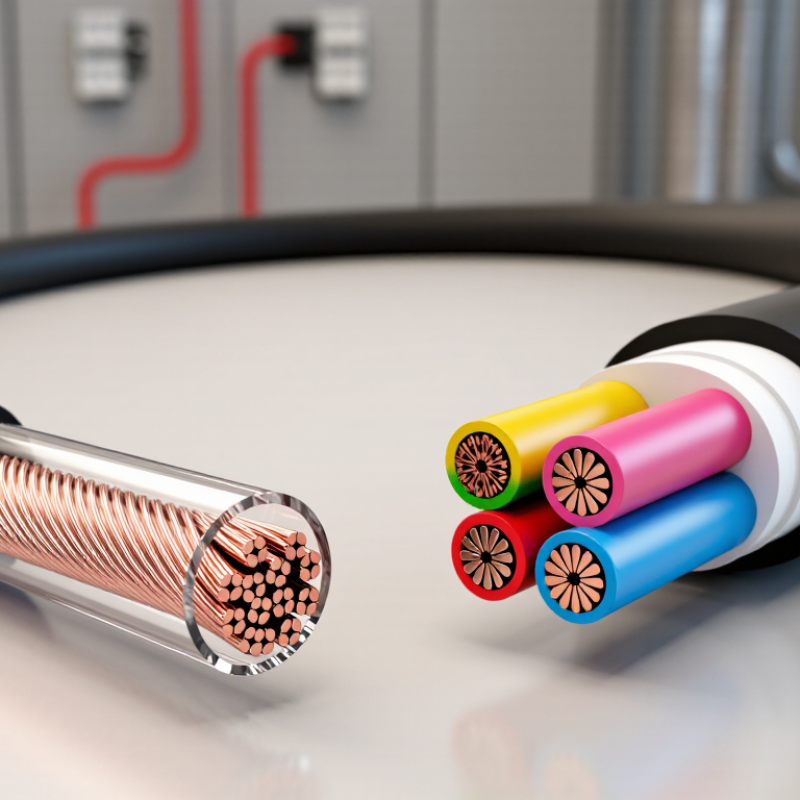
Table of Contents
[Hide]
What Are Wires and Cables?
A wire is usually one electrical conductor, either solid or stranded. It may be bare or covered with insulation. A cable contains two or more conductors, or a conductor with protective layers. Those layers can include insulation, shielding, filler, armor, and an outer jacket. A practical distinction.
In a workshop, a copper wire may connect a terminal inside a control panel. A cable may carry several circuits through a wall, with its jacket resisting moisture and abrasion. However, the boundary is not perfectly universal. IEC 60050 and the National Electrical Code use related, but not identical, terminology. I still check the applicable standard before selecting materials. Names alone can mislead.
Performance depends on more than conductor count. Wire size, insulation temperature, installation method, voltage, and bending space all affect safe operation. The U.S. Energy Information Administration reported transmission and distribution losses of about 5% of electricity supplied in recent annual data. Poor connections and unsuitable conductors can increase waste and heat. The International Energy Agency’s Electricity Grids and Secure Energy Transitions report estimates that over 80 million kilometers of power grids must be added or refurbished by 2040. That scale makes clear labeling and careful cable design essential. One small omission matters. A cable that fits physically may still fail electrically, mechanically, or environmentally.